
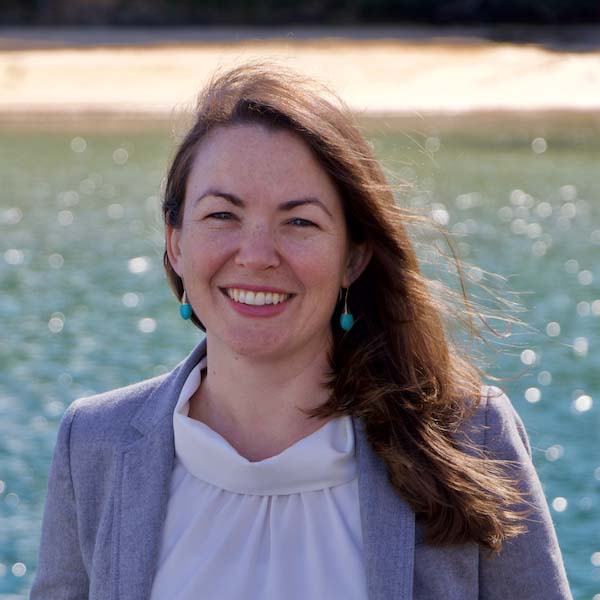
Katherine Dafforn
Director, Stone Living Lab
Biography
Katherine Dafforn is Director of the Stone Living Lab and Distinguished Professor at UMass Boston. An international leader in coastal ecology, she co-founded the award-winning Living Seawalls project and has led global research on restoring marine habitats impacted by built structures. Katherine received her Bachelor of Science (Honors and University Medal) in marine biology and spatial information systems and her PhD in biological sciences from the University of New South Wales, Sydney.
Area of Expertise
Marine and estuarine ecology, microbial ecology, invertebrate biology, biosecurity and invasive species ecology, ecosystem function, environmental management, sediment pollution, stormwater, ecological restoration, climate change adaptation, nature-based solutions
Degrees
PhD, Biological Sciences, University of New South Wales
GradCert, University Learning and Teaching, University of New South Wales
BSc (Hons and University Medal), Marine Biology and Spatial Information Systems, University of New South Wales
Professional Publications & Contributions
Janssen, A. R., Bishop, M. J., Mayer-Pinto, M., and Dafforn, K. A. (2026) Differential copper stress responses in populations of the golden kelp Ecklonia radiata. Marine Pollution Bulletin 222:118934.
Janssen, A. R., Mayer-Pinto, M., Bishop, M. J., O'Hare, J. A., Stow, A. J., and Dafforn, K. A. (2026) Genetic differentiation of habitat-forming kelp Ecklonia radiata across an urban estuary. Marine Environmental Research 213:107613.
Gopakumar, A., Airoldi, L., Dixon, R., and Dafforn, K. A. (2026) Functional equivalence in early-stage decomposition between restored and remnant salt marshes despite differences in associated microbial communities. Journal of Environmental Management.
Barros, TL, Mayer-Pinto, M, Dafforn, KA, Simpson, SL, Farrell, M, Bracewell, S, Johnston, EL (2025) Impact of wildfires on sediment quality in estuaries in New South Wales, Australia. Chemosphere. 385: 144604.
Renn, C, Vadillo Gonzalez, S, Marzinelli, EM, Dafforn, KA, Hart, J, Voerman, SE, Firth, LB, Gribben, PE (2025) Propagule pressure and native macrophyte biomass mediate the success of an invasive alga: the role of below-ground microbial communities. Biological Invasions. 27: 137.
Dafforn, KA (2025) Future-proofing our ports against biological invasion. Current Opinion in Environmental Sustainability. 73: 101518.
Schaefer, N, Bishop, MJ, Herbert, B, Hoey, AS, Mayer-Pinto, M, Sherman, CDH, Foster-Thorpe, C, Vozzo, ML & Dafforn, KA (2025) Major global ports alter light regimes for marine biofouling communities. Journal of Environmental Management. 374: 124119.
Schaefer, N, Hoey, AS, Bishop, MJ, Bugnot, AB, Herbert, B, Mayer-Pinto, M, Sherman, CDH, Foster-Thorpe, C, Vozzo, ML & Dafforn, KA (2025) Shining the light on marine infrastructure: the use of artificial light to manipulate benthic marine communities. Journal of Applied Ecology. 62: 220-230.
Additional Information
My research has focused on the ecological dynamics of urban marine environments, particularly the impacts of human activities on biodiversity and ecosystem functioning. I began by investigating how chemical contaminants and physical habitat modifications influence the success of invasive species, conducting large-scale experiments across estuaries with results that informed antifouling policy in Australia, New Zealand, and the USA. This foundational work evolved into applied research on ecological engineering of built structures, where I collaborated with industry partners like Lendlease to develop multifunctional built infrastructure that supports biodiversity and ecosystem health. These efforts culminated in the co-founding of the Living Seawalls project, which integrates ecological design into urban marine structures to enhance biodiversity.
In my current role as Director of the Stone Living Lab I am designing and testing innovative nature-based approaches to enhance coastal resilience while delivering benefits beyond biodiversity such as water quality and shoreline protection. My team has conducted foundational research demonstrating how human-made structures select for species with distinct functional traits, influencing ecosystem processes. We’ve shown that increasing physical and biogenic complexity through eco-engineering can enhance species richness and particle removal, contributing to improved water clarity. These findings are critical as we seek to develop nature-positive solutions for increasingly urbanised coastlines. Through projects like Living Seawalls, I aim to continue advancing scalable, evidence-based designs that integrate ecological restoration with coastal protection.
My research has also explored the biogeochemical processes that underpin ecosystem function in urban estuaries, with a strong focus on developing nature-based solutions for coastal restoration. I have led large-scale experiments to quantify nitrogen removal and disentangle the roles of oysters, sediments, and their interactions. My team has shown that cross-habitat coupling enhances biodiversity through organic matter provisioning, and that dense oyster patches can act as hotspots for denitrification. A key part of my work connects ‘omics with benthic ecology—an area I believe is often overlooked. My team has demonstrated that restoring sediment-dwelling animals increases denitrifying microbial communities and remineralisation, offering promising strategies for remediating contaminated sediments. We’ve also found that microbial communities near stormwater drains are distinct and dominated by sulphur-reducing bacteria, and have used metatranscriptomics to link gene expression to nitrogen and sulphur cycling, revealing potential greenhouse gas production in contaminated sediments. By integrating macrofaunal, microbial, and biogeochemical research, I aim to deliver scalable, evidence-based interventions to support the recovery of degraded coastal systems.