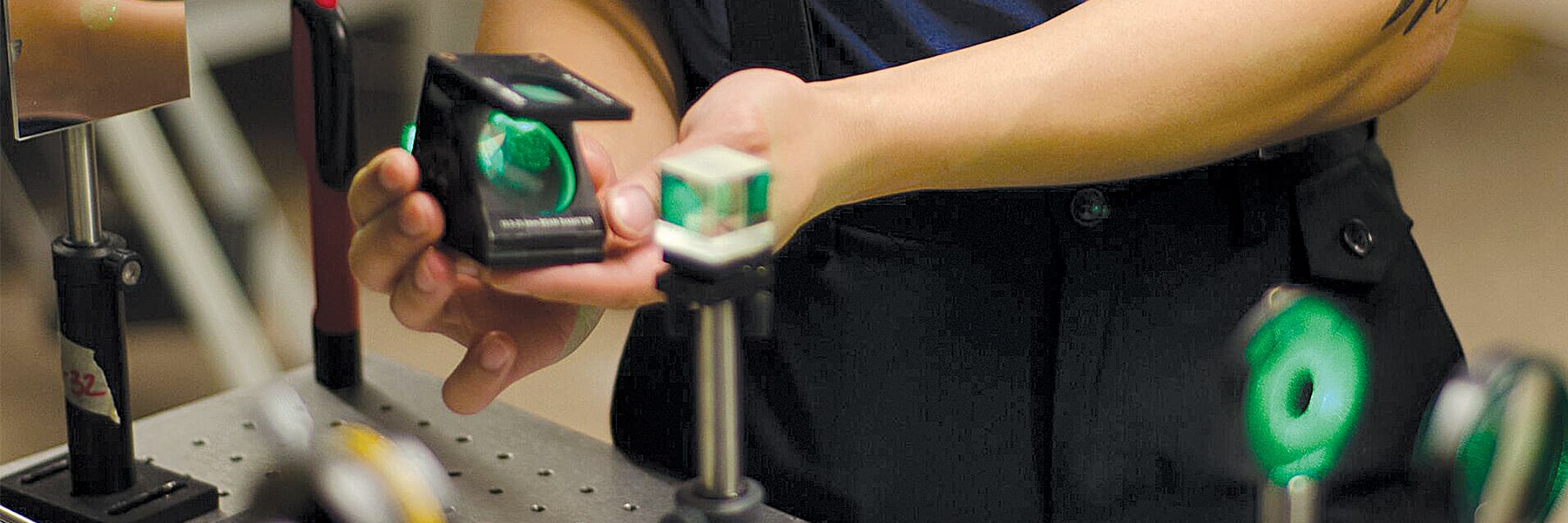
Plan Your Education
How to Apply
Students may apply directly to the PhD program with either a bachelor’s or master’s degree. The program provides rigorous graduate training through advanced coursework, original research, and close faculty mentorship.
Applicants must meet general graduate admission requirements in addition to the following program-specific requirements:
- A minimum, cumulative GPA of 3.0 on a 4.0 scale (or international equivalent) in graduate work
- A grade of B or higher in calculus and higher-level math classes such as linear algebra, ordinary differential equations, partial differential equations, and complex analysis
- A grade of B or higher in physics courses, especially in undergraduate quantum mechanics courses
- Statement of Purpose: This is your opportunity to show the graduate admissions committee why you wish to pursue graduate study, as well as your specific interests and goals. The applicants must specify name of the faculty or groups at UMass Boston they would like to work with.
- Three letters of recommendation. Letters from non-academic associates are accepted, but at least one letter must speak authoritatively to the student’s academic preparation.
- Résumé or CV
- The GRE is required.
- Official transcripts for all institutions where you have earned more than 6 credits. If your transcript is in a language other than English, please include an English translation, validated by an official public translator.
- Applicants who completed the majority of their undergraduate coursework outside of the United States are typically required to submit official TOEFL, IELTS, PTE or Duolingo English proficiency test scores.
Deadlines & Cost
Deadlines: February 15 for fall; November 1 for spring
Application Fee: The nonrefundable application fee is $75. UMass Boston alumni and current students that plan to complete degree requirements prior to graduate enrollment can submit the application without paying the application fee.
Funding:
Qualified PhD students are typically supported through:
- Teaching Assistantships
- Research Assistantships
- Faculty research grants
- Fellowships when available
Funding packages include tuition waiver, a competitive stipend, and opportunities for professional development through teaching and research.
Program Cost Information: For more detailed information on costs, please visit the Bursar's website.
Research Areas
This research-intensive environment provides students with opportunities to tackle challenging scientific problems while preparing them for leadership careers in academia, government laboratories, and high-technology industries.
Research Areas
Quantum Science
- Quantum Information Science
- Quantum Computing
- Quantum Foundations
- Atomic, Molecular and Optical (AMO) Physics
- Quantum Many-Body Physics
Biophysics, Photonics & Soft Matter
- Biological Physics
- Cancer Biophysics
- Biomedical Optics and Imaging
- Photonics and Nonlinear Optics
- Soft Active Matter
- Neuroscience
Condensed Matter, Complex Systems & Physics of AI
- Condensed Matter Theory
- Complex Systems
- Statistical Physics
- Physics of AI
Curriculum
Core Courses (16 Credits)
Complete the courses below if not already taken as part of the MS degree.
Courses may be waived if the student passes the corresponding examination section prior to enrolling in the course.
- PHYSIC 611 - Theory of Classical Mechanics and Fluid Mechanics 4 Credit(s)
- PHYSIC 612 - Electromagnetic Theory 4 Credit(s)
- PHYSIC 613 - Quantum Mechanics, Atomic, and Molecular Physics 4 Credit(s)
- PHYSIC 614 - Thermodynamics and Statistical Mechanics 4 Credit(s)
Electives (32 Credits)
Complete eight from below.
Courses already completed for the MS may be applied toward this requirement.
- PHYSIC 600 - Electronic Instrumentation I: Analog 4 Credit(s)
- PHYSIC 601 - Electronic Instrumentation II: Digital 4 Credit(s)
- PHYSIC 602 - Laser Optics Laboratory 4 Credit(s)
- PHYSIC 607 - Experiments in Squishy Physics 4 Credit(s)
- PHYSIC 610 - Topics in Medical Imaging 4 Credit(s)
- PHYSIC 616 - Mathematical Methods for Physicists 4 Credit(s)
- PHYSIC 632 - Advanced Laser Optics (with Lab) 4 Credit(s)
- PHYSIC 635 - Physics on the Back of an Envelope (Estimation in Physics) 4 Credit(s)
- PHYSIC 638 - Quantum Measurement Theory 4 Credit(s)
- PHYSIC 645 - Cancer Biophysics 4 Credit(s)
- PHYSIC 662 - Computational Science 4 Credit(s)
- PHYSIC 680 - Readings in Physics 3-6 Credit(s)
- PHYSIC 690 - Projects in Physics 3-6 Credit(s)
- PHYSIC 697 - Special Topics in Applied Physics 1-8 Credit(s)
Dissertation (24 Credits)
- PHYSIC 899 - Doctoral Dissertation Research 1-15 Credit(s)
For more information on curriculum, including course descriptions and degree requirements, visit the Academic Catalog.
Learning Outcomes 2025
- Students acquire appropriate competence in physics foundations and have been given a working knowledge of methodologies in a wide range of sub-fields in modern physics.
- Students acquire competence in laboratory skills and can work independently.
- Students acquire the ability to select from an array of analytic and computational tools to solve specific problems.
- Students are able to scientifically justify this decision and gauge its efficacy.
- Students acquire competence in laboratory skills and can work independently.
- Students acquire the ability to select from an array of analytic and computational tools to solve specific problems.
- Students are able to scientifically justify this decision and gauge its efficacy.
- Students demonstrate the ability to extend ideas from one area of physics to problems in other areas or disciplines.
- Students are broadly aware of the challenging and open problems of the day.
- Students are encouraged to engage in research at the earliest opportunity.
- Students can relate and articulate the connections between abstract theoretical constructs and reality.
- At the doctoral level we are training independent researchers who will be able to take the skills of a Physicist and apply them as independent researchers to a broad range of problems.
- At the graduate level, we also seek to create a path that allows students from non-physics backgrounds to be trained in physics. This allows us to recruit strong students from outside the traditional Physics pipeline. Furthermore, it creates an opportunity for students who discover their vocation late to re-enter the Physics education system. Students acquire appropriate competence in physics foundations and have been given a working knowledge of methodologies in a wide range of sub-fields in modern physics.
- At the graduate level, we also seek to create a path that allows students from non-physics backgrounds to be trained in physics. This allows us to recruit strong students from outside the traditional Physics pipeline. Furthermore, it creates an opportunity for students who discover their vocation late to re-enter the Physics education system.
Graduation Criteria
Complete 72 credits from 18 courses, including four core courses, eight electives, and 24 credits of dissertation courses.
Doctoral candidacy: Completion of the foundational and lab courses of the MS program and passage of written comprehensive examinations and an oral candidacy examination.
Dissertation: Compose and defend a dissertation based on independent experimental or theoretical research. For students who have already published at least one peer reviewed article in a high impact journal, their published work may be used in place of a dissertation at the discretion of the committee and graduate program director, though an oral defense is still required.
Statute of limitations: Eight years.
Contact
Graduate Program Director Stephen Arnason
stephen.arnason@umb.edu
(617) 287-6068
Administrative Manager Moriah Roache
moriah.roache@umb.edu
(617) 287-6092
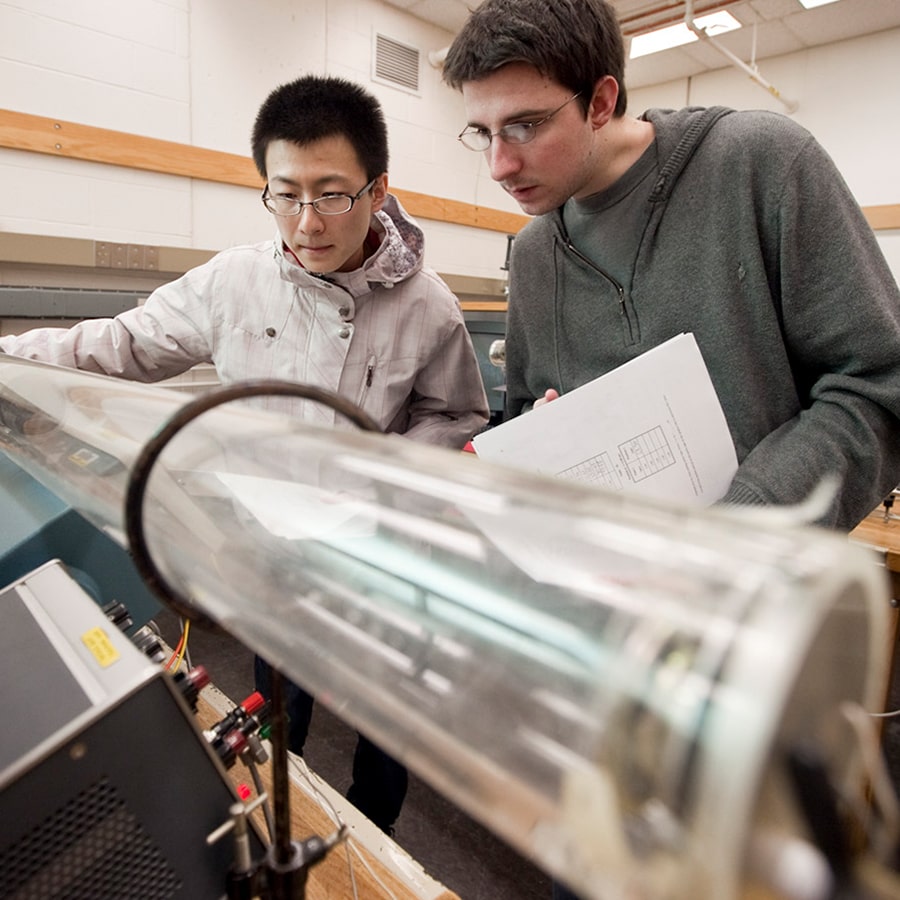
Department of Physics
Learn more about UMass Boston's Physics department, our research, and our faculty.
Explore the Department of Physics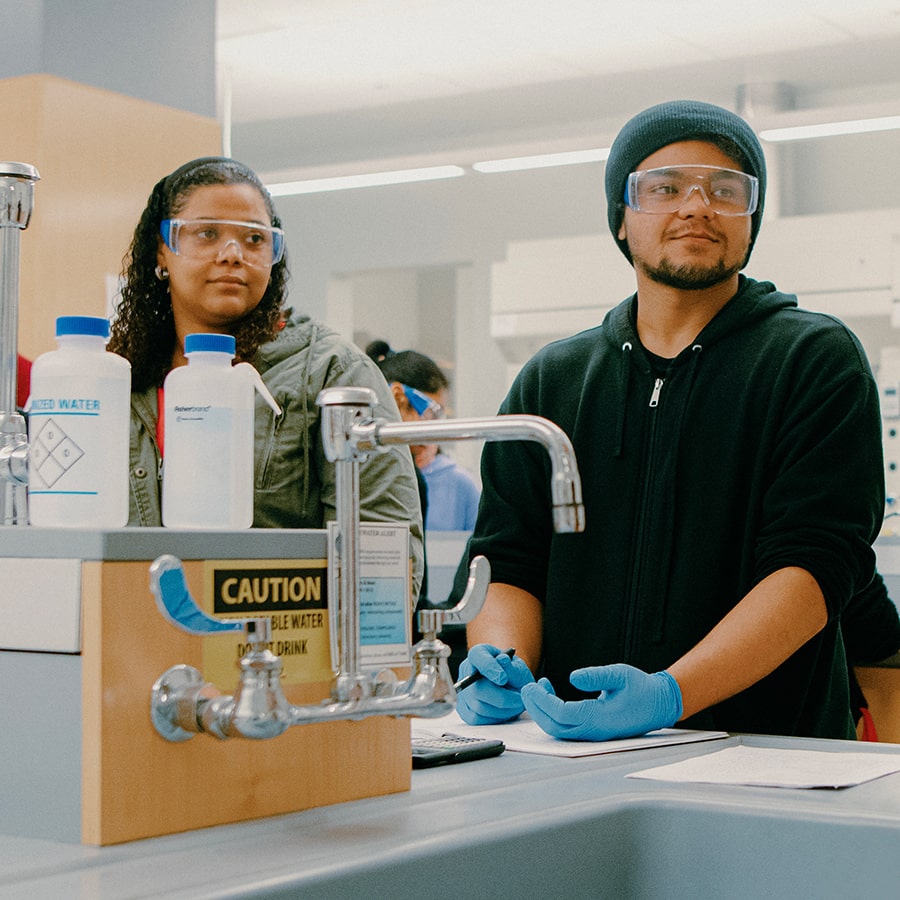
College of Science & Mathematics
Learn more about the faculty, research, and programs that make up our College of Science and Mathematics.
Explore Now