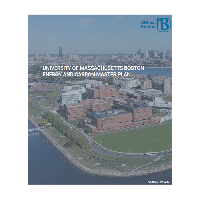
The goal of theEnergy and Carbon Master Plan, published in 2023, was to provide potential pathways for practical, cost-effective energy efficiency, electrification, on-site renewable, and resiliency solutions. The result was a review of the viability of technology options to eliminate burning of onsite fossil fuels by 2050, the majority of which is from natural gas used to heat the campus via the Central Utility plant. In addition the capacity for expanding roof top solar photovoltaics was studied. In 2026 both new funding resources and advancing the engineering design process allowed acceleration of the published timeline for installing Heat Shift Chillers, the chosen decarbonization technology for the Central Utility plant. In addition contracts were signed for Bright Beacons Solar Project, consisting of 4 new rooftops.
Bright Beacon Solar Project
Expanding PV for UMB
New projects
Quinn Building Roof- 210.72kW DC, construction beginning August 15, 2026
McCormack Building Roof (279.8kW DC), construction beginning Fall 2026
Campus Center Roof (279.36 kW DC), roof repair underway in Spring 2026, solar construction in 2027
West Garage Canopy (232.8kW DC), estimated 2027 construction
Upon completion information will be shared about real time energy production and environmental impact.
UMass Boston Receives Decarbonization Grant for Renewable Thermal Heating System
With $5.3 million in funds from the Massachusetts Department of Energy Resources, the university will be able to implement innovative decarbonization efforts utilizing its harborside location.
By implementing a range of initiatives and investments, UMB aims to meet environmental mandates, significantly reduce emissions, and create a sustainable campus for the future.
Sustainability and environmental justice are key themes of the recentCampus Master Plan. The Master Plan incorporates strategies including energy-efficient buildings, renewable energy sources, recyclable and locally available materials, and clean transportation alternatives. The concurrently developed Energy & Carbon Master Plan aims to operationalize these strategies and meet state climate change reduction goals. Through this plan, UMass Boston will meet the goals of Executive Order 594.
Executive Order 594 establishes iterative miles to reduce GHG emissions from state government operations, aligning with the statewide goal of achieving net zero greenhouse gas emissions by 2050.