Aimina Talley: Supporting Children with Visual Impairment
Parents are still denying the fact that their kids have disabilities.
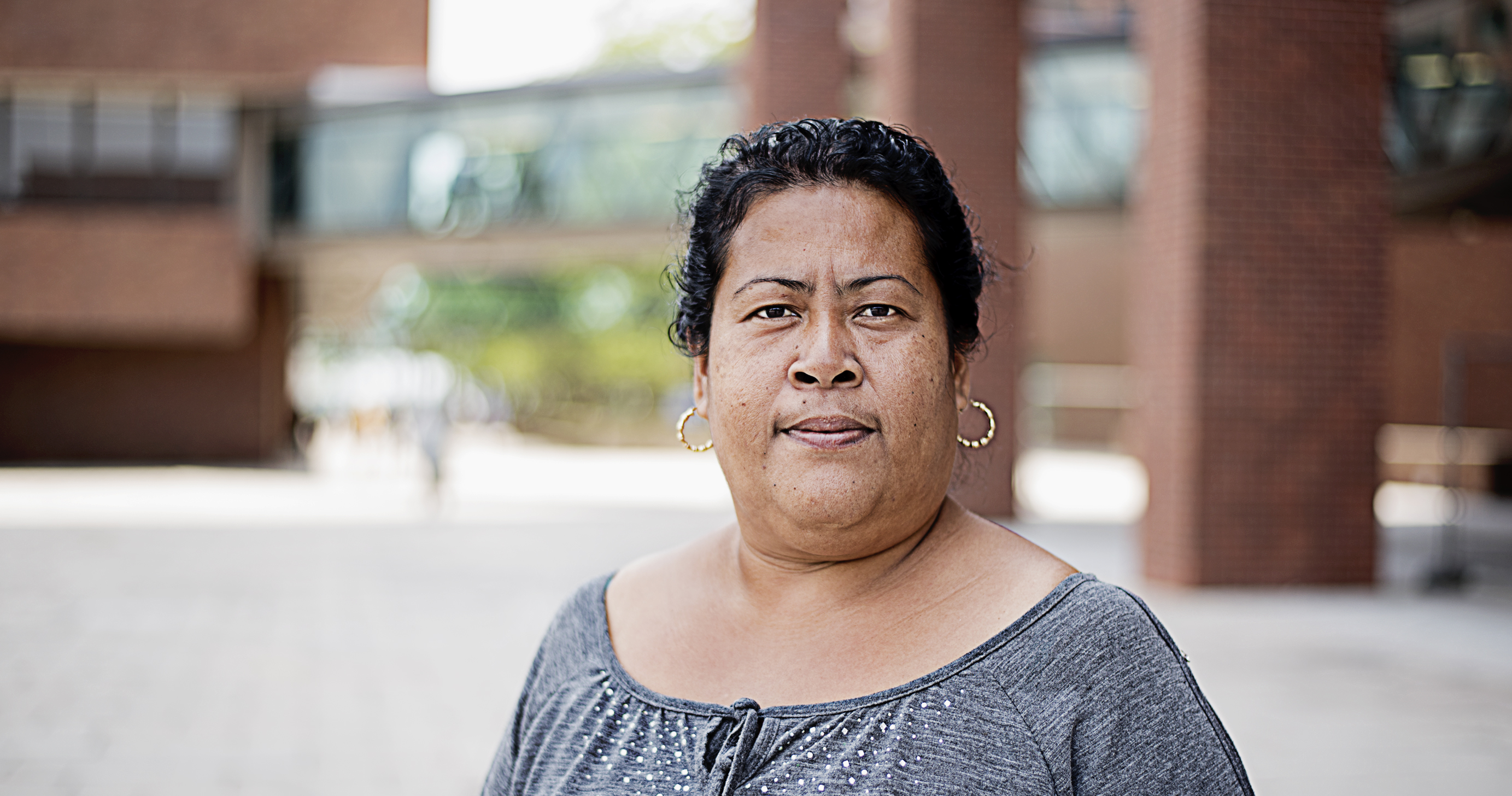
Aimina Talley grew up on the island of Kosrae in the Federated States of Micronesia. She works at a center that provides services to children with disabilities. A few years ago, she heard through a friend about UMass Boston’s School for Global Inclusion and Social Development, and the long-distance Vision Studies Program.
Talley was attracted to the convenience of the program, which is almost entirely online. Like many of its other graduates, she sees vision studies as an area of growth and need in the Pacific Islands and beyond.
Meeting children’s needs
On Kosrae, the center where Talley works supports children with a range of disabilities, from birth to age 21. She began to learn more about visual impairment (VI) when the Braille teacher at the center became ill, and other staff had to help take on that teacher’s responsibilities.
“It got to a point where each of us needed to learn something from her, in order to help her students,” Talley explained. “Nowadays we don’t have that many students with VI, but I know pretty soon we’re going to have more coming in.”
Children get referred to the center by their families or by public health services. “Parents are still denying the fact that their children have disabilities,” Talley noted. However, she says this is starting to change.
She and her colleagues began running a series of workshops in local communities about disability services for children. “After that,” she said, “parents started to come forward.” This is especially true of parents whose kids have VI or hearing loss.
Obstacles still remain. “Some of the parents, they’re not that sure of how to refer or what do to with their kids,” said Talley. She and her colleagues encourage honest discussion of disability, and focus on supporting children to thrive inside and outside their homes.
Hands-on learning
One class that stood out to Talley was Orientation & Mobility (O&M). O&M is the area of vision studies that helps people navigate and get around independently.
During a two-week in-person session on the island of Guam, Talley and her fellow students had to test their own navigation skills by being blindfolded and crossing the street at a busy intersection. “It was nerve-racking, but exciting as well,” Talley said.
Bringing back experience
Talley’s favorite part of her job is going out on home visits to meet kids and their families. She plays games with the children, and teaches parents how to care for children with more significant health care needs. She also performs motion exercises and other activities to strengthen the kids and increase their self-sufficiency.
She and her colleagues share their expertise with family members, and learn from them as well. The center’s staff are skilled in disability-related supports, while the parents have a deep understanding of their kids’ challenges and strengths.
Now that she has earned her MEd in vision studies, Talley plans to apply what she learned at UMass Boston to her job at the center on Kosrae: “I hope it gives me more time, more privilege to work with more VI students.”
Questions for Aimina Talley
What makes the Vision Studies Program special?
It relates perfectly with what I do as a service provider. I’m very fortunate to have worked with everyone: the faculty and the other students.
If you had to describe your fellow students in one word, what would it be?
Success. We came a long way. We all just worked together for our mission. All of us succeeded, not only in getting our master’s but in learning from one another.