A Recipe for Change
How Emily True ’15 is helping Pizza Hut turn global sustainability goals into everyday action.
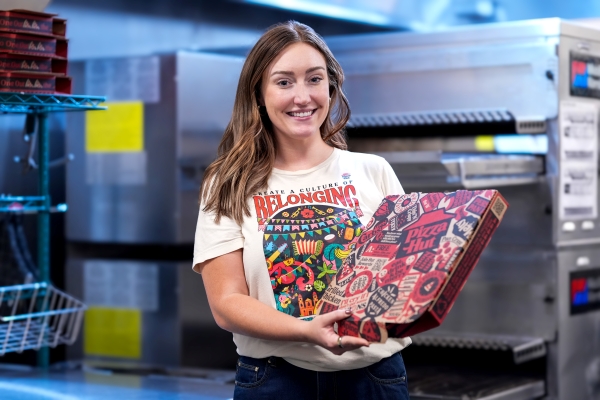
The pizza box on your kitchen counter is more complex than it looks.
So is the order inside it. Long before dinner arrives, a pizza has already been shaped by a chain of decisions about ingredients, packaging, energy use, regulations, suppliers, restaurants, and waste—all of which influence its environmental impact before you take your first bite.
Where did the cheese come from? How much energy did the restaurant use? Can the box be recycled? What materials went into the packaging? Emily True ’15, director of global sustainability at Pizza Hut, spends her days tackling those questions— and asking the larger one behind them: What does it take for a global brand to lower the environmental impact of a pizza order without putting the onus on the customer?
Yum! Brands, Pizza Hut’s parent company, has committed to reducing packaging waste, eliminating unnecessary plastics, cutting food loss and waste, and moving consumer-facing plastic packaging toward reusable, recyclable, or compostable materials. True’s role—the first of its kind at Pizza Hut—is to bring those commitments out of the corporate stratosphere and into the everyday realities of restaurants, franchisees, and customers.
“My job was taking Yum!’s sustainability strategy and translating it into action for Pizza Hut,” True said. “While we had a strong foundation to build from, there’s a real opportunity to define what that strategy looks like for our brand. It’s really exciting to help bring that vision to life.”
A Global Brand, an Everyday Impact
Part of what makes the role so exciting—and so consequential—is Pizza Hut’s global scale. True had worked in corporate sustainability before joining the company, including at Conagra Brands, where she led efforts to create a set of carbon neutral products under the EVOL brand. But Pizza Hut offered a different kind of reach.
“I don’t think I fully appreciated Pizza Hut’s global footprint before I joined,” she said. “With restaurants in more than 100 countries and nearly 20,000 locations, the scale was really exciting to me. That was one of the things that drew me to the role. It felt like the world was opening.”
That scale is also what makes corporate sustainability so powerful, True said: the chance to work within a system so large that changes in sourcing, packaging, restaurant operations, and consumer guidance can influence not only Pizza Hut’s own environmental footprint, but also the expectations placed on suppliers, partners, and the broader industry.
Learning to See the Whole System
As a student at UMass Boston, True majored in environmental science and pursued certificates in geographic information systems and clean energy, using her undergraduate years to explore different corners of a field that was still taking shape. She later earned a master’s degree in environmental management from Duke University, where a professor helped her see corporate sustainability as a path for driving change from within.
“A lot of people still have a perception that companies are primarily focused on business goals and may not always prioritize environmental or social issues,” True said. “But once you’re within a company, you can often have an even bigger impact than through many of the other paths I was considering.”
At UMass Boston, True said, she began developing the systems-oriented thinking she now relies on every day. Her professors helped make environmental change feel measurable and tangible, from using GIS to study changes in ecosystems to examining the relationship between farmers markets and income levels across Boston neighborhoods. She remembers reading Wicked Problems: How to Engineer a Better World by Guru Madhavan in a class with former Professor of Hydrology Ellen Douglas, a book that helped her understand environmental challenges as interconnected problems without simple answers.
“That was the first time I understood it’s not just black and white,” True said. “These environmental problems are so large, and there isn’t one solution. There are so many trade-offs, and everything is interconnected.”
That lesson has followed her into her work at Pizza Hut, where even a seemingly straightforward question—how do you reduce the environmental impact of a pizza order? — quickly expands into questions about sourcing, operations, packaging, and customer behavior.
“I look at what our carbon footprint is and where we can make the most change,” True said.
Where Change Takes Shape
One area is a signature Pizza Hut ingredient: cheese. Through a partnership with Dairy Farmers of America, Pizza Hut has provided U.S. farmers with technology and data aimed at reducing on-farm greenhouse gas emissions. The project has decreased the emissions intensity of the milk used in Pizza Hut cheese by 10 percent among participating farmers. The company is piloting similar efforts in New Zealand and the United Kingdom.
Another focus is the restaurants themselves: ovens, refrigeration, lighting, HVAC systems, exhaust hoods, and other everyday energy uses that keep a Pizza Hut running. Pizza Hut has been developing sustainability guidance designed to help restaurants conserve resources while helping franchisees save money—a practical example of how environmental goals and business needs can work together.
“You can care about sustainability and still drive meaningful business results,” True said. “There’s a belief that sustainability always comes with a cost, or that sustainability and business performance are usually at odds. In some cases, that’s true. But increasingly, they’re intertwined.”
Thinking Outside the Box
Part of True’s work has involved correcting a misconception as familiar as the pizza box itself. For years, many consumers have believed that greasy pizza boxes cannot be recycled. True thought the same thing growing up. But studies have shown that pizza boxes with typical levels of grease do not necessarily compromise the quality of recycled cardboard bales. So Pizza Hut is working to give customers clearer information about what to do with their boxes after the meal is over.
Today, Pizza Hut boxes in the United States include a QR code directing customers to recycling information based on their location. The language, True said, is intentionally simple and consumer friendly—a way to help customers pause before tossing the box and ask, “Wait, can I recycle this?” “That’s the conversation we want,” True said. “We want people to go home and have debates with their partners about whether the pizza box can be recycled.”
Small Wins in a Big System
For a global brand, those small moments matter. A clearer label, a more efficient restaurant, a better supplier partnership, a stronger internal business case—each one is part of a larger system. And for True, operating inside that system means accepting that the answers are rarely simple, the progress is often incremental, and the work requires both patience and persistence.
“Be comfortable with ambiguity,” she said. “You don’t always have all the answers. Give yourself credit for the small wins.”
The next time a pizza box lands on the kitchen counter, it might still look unremarkable to you. But to True, it is part of something much larger: a global system of choices, trade-offs, and steps toward a sustainable future—one slice at a time.