At Convocation, Ashish Jha Urges Students to Protect the Human Core of Education in Age of AI
Jha and Chancellor Marcelo Suárez-Orozco challenge Beacons to think critically and preserve the human core of education in the age of AI.
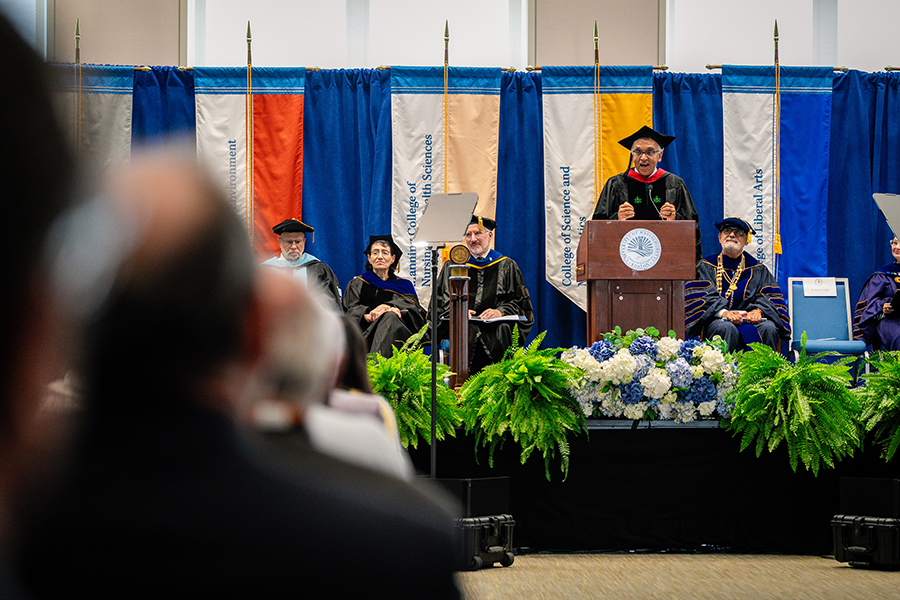
At UMass Boston’s 2026 Fall Convocation, former White House COVID-19 Response Coordinator Ashish Jha urged Beacons to build judgment, embrace difference, and use AI to extend—not replace—their thinking. Jha challenged UMass Boston students to think critically, embrace uncertainty, and seek out perspectives different from their own as they navigate an increasingly AI-driven.
Jha, a physician, scientist, and one of the nation’s most trusted voices on biosecurity and biological threats, told students, faculty and staff that artificial intelligence can expand what they are capable of doing, but cannot replace the judgment, curiosity, and humility that come from education and experience.
“The challenge is not whether you will use AI,” Jha said. “The challenge is whether you will use AI to extend your thinking, or whether you will allow it to replace your thinking. AI can give you answers, but it can't tell you which questions to ask.”
Jha opened his remarks with the story of his family’s move from India to North America when he was 8 years old. His father left a stable government job without knowing exactly where the decision would lead—a leap of faith Jha said mirrors the experiences of many UMass Boston students.
“One of the reasons I love this place is because every time I am here, I'm reminded that my family's story is like so many other people's story in this room,” he said.
Jha pointed to UMass Boston’s diversity, noting that students come from more than 100 countries and that more than half are the first in their families to attend college. He encouraged students to embrace the uncertainty that comes with learning and reminded them that they belong. Watch the full convocation address on UMass Boston's YouTube channel.
‘You can’t download judgment’
Jha cautioned students that while AI can provide answers quickly and confidently, confidence is not the same as wisdom.
“Sometimes the answers it will give you are right, and sometimes the answers it will give you are wrong,” he said. “And it will sound exactly the same either way.”
Drawing on his experience during the COVID-19 pandemic, Jha said navigating uncertainty required expertise, judgment, and humility.
“You can’t download judgment,” he said. “It’s something you build over time. The faculty at this university have built judgment throughout their careers. And starting today, they will help build yours.”
That judgment, he said, comes from asking good questions, listening to people with different perspectives, testing ideas against evidence, and being willing to be wrong.
Chancellor reflects on AI and the importance of human judgment
Jha’s message echoed remarks from Chancellor Marcelo Suárez-Orozco, who opened Convocation by reflecting on the future of scholarship and scientific discovery in the age of AI.
Suárez-Orozco said AI will accelerate research and expand human inquiry, but the most pressing challenges, from climate resilience to advancing human health and building a more just society, will require collaboration across disciplines and the distinctly human qualities of curiosity, imagination, conscience, and creativity.
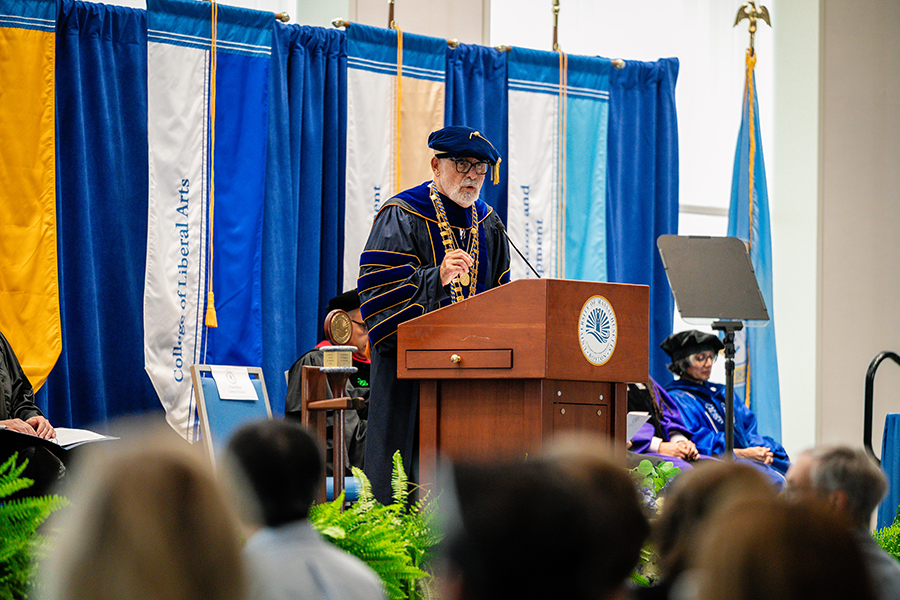
“AI can help identify what problems may be solved, but it cannot tell us, by itself, which problems matter most, or what they mean for the human spirit,” Suárez-Orozco said.
He urged students to become fluent in data and emerging technologies while remaining grounded in ethical integrity and humanistic reflection.
“Education, at its best, cultivates the timeless joy of learning how to learn,” he said.
Suárez-Orozco closed by emphasizing that technology’s ultimate value must be measured by its ability to serve people.
“AI and machine learning will always require a steady human hand to guide them—a hand grounded in wisdom, humility, and an ethic of care,” he said. “For a humane future, the human hand must be at the till of all technologies: we must remain the directors, questioners, and moral stewards of scholarly knowledge.”
Provost highlights UMass Boston’s commitment to access, excellence, and public impact
Earlier in the program, Provost Joseph Berger welcomed 32 new tenure-track faculty members recruited to campus this year through national searches. He also congratulated 51 faculty who have been recognized for being promoted to the rank of associate professor, full professor, and senior lecturer.
Berger said the university begins the year at a consequential moment, but that today’s political, economic, and social pressures do not diminish its purpose—they clarify it.
“This is a time to demonstrate what it means to be a university of and for the times—no matter the times. It means protecting the integrity of teaching and scholarship; supporting the academic freedom and free speech necessary for discovery and informed debate; and ensuring that students from every background experience the belonging, encouragement, and opportunity they need to succeed,” Berger said.
As Boston’s public research university and the nation’s most accessible R1 research university, UMass Boston is advancing access and excellence by improving student success, expanding experiential learning and pathways, growing research and innovation, and strengthening partnerships across Boston and the Commonwealth.
“Our work is local in its commitments and global in its relevance. We are addressing urgent challenges in areas such as climate resilience, health equity, responsible artificial intelligence, educational opportunity, and inclusive economic development,” Berger said. “Our integrity requires that we remain deeply engaged with the communities closest to us, even as the knowledge, models, and solutions developed here contribute to a rapidly changing world.”
Student leaders ring the Beacon Bell
Earlier in the program, Chancellor Suárez-Orozco recognized Christopher Nasr with the 2026 Ryan Award. The Ryan Award is given to the student who has achieved the highest cumulative average for four semesters in residence during the freshman and sophomore years.
As part of a convocation tradition, Vice Chancellor for Student Affairs Karen Ferrer-Muñiz welcomed Graduate Student Government President Simran Pattnaik and Undergraduate Student Government Vice President Simone Trainor to the stage to formally request investiture of our newest students as members of the Beacon community.
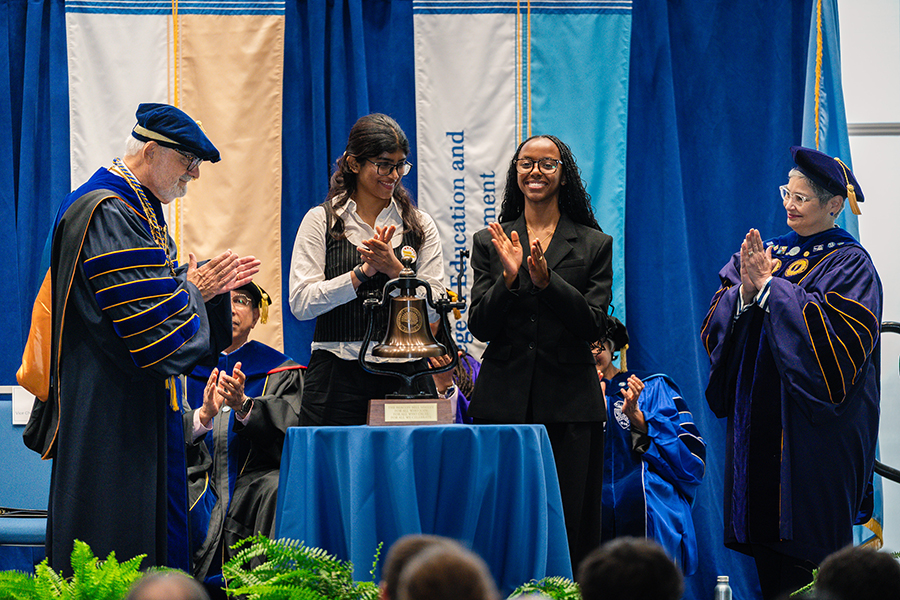
The students rang the Beacon Bell, to celebrate the newest Beacons joining the larger UMB family.
“We look forward to the knowledge you will gain, the friendships you will form, and the impact you will have on this campus and beyond,” Suárez-Orozco said.