Groundbreaking Work
As Boston's city archeologist, Joe Bagley G'13 uncovers the buried stories, overlooked communities, and ancient landscapes that reveal a deeper history of Boston.
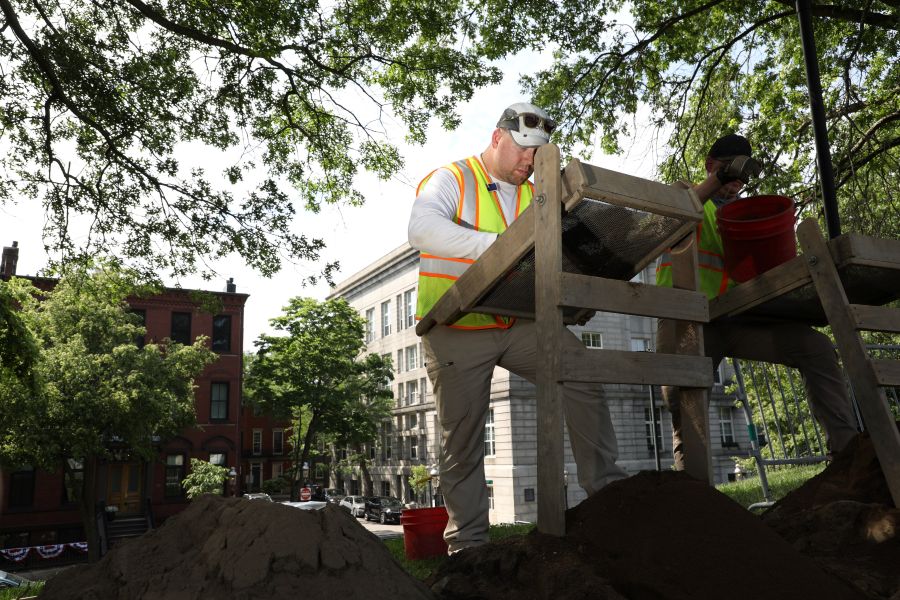
In Boston, history is easy to find. It is etched into brick and steeple, marked by plaques, worn into cobblestones, and mapped onto walking tours that promise to carry visitors through entire centuries in an afternoon.
These tours offer a version of Boston’s past that feels orderly and easy to follow: one landmark after another, one name after the next. Here are the famous men, the famous words, the famous battles. Here are the meetinghouses and monuments. Here is the city’s layered past compressed into a 90- minute story you can follow in a pair of comfortable walking shoes.
Joe Bagley G’13 has built a career out of asking what is missing from that story—and who should help tell it. As Boston’s city archaeologist and director of archaeology, Bagley looks beneath the version of Boston most people are taught to recognize, recovering evidence of the lives that rarely appear in those tour scripts or textbooks: Indigenous communities, enslaved people, immigrants, laborers, women, children, and generations of families whose homes, work, and belongings tell stories the official record often missed.
“There’s a lot that happened that just isn’t written about, or was written about incorrectly, or is written about in a very biased way,” Bagley said. “The written record is typically written by, for, and about adult white men—but that’s a fairly small percentage of the population.”
Below the Surface
The rest of the story is where Bagley’s work begins. A single week can send him from a full day of research to a walkover survey on the Boston Harbor Islands, from coordinating transportation to Thompson Island to helping decide whether construction activity in Roxbury should trigger an archaeological dig.
“That’s one of the best things about the job: It is incredibly variable,” Bagley said. “It’s hard to predict, but that also makes it fun, because it’s always different, and the projects that we’re working on are always totally different topics.”
Hundreds of topics, in fact. Established in 1983, Boston’s City Archaeology Program is responsible for more than one million artifacts recovered from dozens of sites across the city. Some were excavated decades ago and still require cataloging, photography, and proper storage. Others emerge through current surveys, construction reviews, public archaeology programs, and community digs designed around questions archaeology may be able to answer.
Bagley describes his work as an iceberg. “The ice above the water is research, the ice below the water is analysis, and the line of the water itself is the dig,” he said. “It’s the shortest, briefest part, but it’s also the most visible.”
Despite what films like the Indiana Jones or National Treasure series suggest, archaeology is rarely a rush of spectacular discoveries. Most of the work happens before and after the dig—off-site, in the methodical labor of reading old deeds, comparing maps, studying soil layers, cataloging artifacts, consulting oral histories, and asking what each object can reveal once it’s placed in context.
“What we’re doing is filling in some of the gaps that exist in the story of Boston,” Bagley said. “We don’t need people to be John Hancock and Samuel Adams to be important to the storytelling of Boston. They are. But there are a lot of other pieces that are just as interesting to this place that we can get through the archaeology.”
Finding His Way to the Field
Bagley’s route into archaeology began far from Boston’s brick sidewalks and buried foundations. He grew up in rural western Maine, a first-generation college student with little sense of the careers available beyond the practical jobs he saw around him.
“I didn’t have a clear sense of what I wanted to do growing up,” he said. “I didn’t even know what options were out there.”
In high school, he went looking for something scientific, adventurous, and capable of taking him somewhere new. He found Boston University almost by accident, searching “Boston” and “university,” and came across archaeology in the list of programs. “This sounds amazing,” he remembered thinking. “It’s science, it’s adventure, it’s discovery.”
After BU and several early career detours, UMass Boston brought archaeology back within Bagley’s reach. His wife, Jen, who earned her graduate degree in archaeology from UMass Boston in 2011, told him about a Native site in Grafton where Stephen Mrozowski, founding director of the Andrew Fiske Memorial Center for Archaeological Research, was working. The project connected Bagley’s interest in Native archaeology with the university’s strengths in historical, environmental, urban, and Indigenous archaeology. He enrolled, completed field school before his first semester, and later based his award-winning thesis, “Cultural Continuity in a Nipmuc Landscape,” on the Grafton site where it all started.
Not long after enrolling at UMass Boston, Bagley learned that Ellen Berkland, then Boston’s city archaeologist, was leaving the role. He knew Berkland from his senior year at BU, when he worked on her team at the City Archaeology Lab analyzing Native American artifacts excavated from Boston Common by former City Archaeologist Steven Pendery. The position sounded like everything he wanted, but the timing felt impossible: He had only just begun graduate school and assumed he would not be qualified for at least another two years.
“This is my job,” he remembered thinking. “I wanted it so badly, I can’t even explain it. It had everything: Native archaeology, historic archaeology, public engagement, excitement, discovery. It felt like exactly where I was supposed to be.”
A citywide hiring freeze in the aftermath of the Great Recession slowed the search long enough to give Bagley a chance. When the position was finally posted, a master’s degree was preferred, not required. He knew the job would draw archaeologists from across the field, so he made the case that his range of experience was the point.
“My big selling point was that I can do it all,” he said. He chose references just as carefully, asking each to speak to a different element of his skillset and expertise. “I remember being so strategic about it.” Bagley started graduate school at UMass Boston in September. The city archaeologist job opened in October. He was hired for the role in November and began in December.
Making Boston’s Past Public
Within a few years, his work had drawn national recognition. In 2016, Bagley received the John L. Cotter Award from the Society for Historical Archaeology, an early-career honor recognizing his construction review work, leadership of the City Archaeology Lab, public presentations, volunteer training, and creative use of social media to bring the public into active archaeological research.
A decade later, his books include A History of Boston in 50 Artifacts, which uses objects from ancient spears to chinaware to tell a 10,000-year history of the city, and Boston’s Oldest Buildings and Where to Find Them, an award-winning guide to 50 pre-1800 structures and the preservation efforts that kept them standing. Earlier this year, he and fellow UMass Boston alumna Holly Herbster G’05 published The Historical Archaeology of Massachusetts, widening the lens to four centuries of archaeology across the commonwealth. Together, the books invite readers to look more closely at the objects, buildings, and buried evidence that expand Boston’s familiar story.
At the Speed of Trust
For Bagley, though, public archaeology also carries a responsibility: to ask who gets to frame the questions, interpret the evidence, and decide what should be shared.
“What an archaeologist wants to know and do is one thing,” Bagley said, “but what a community cares about and wants to know is oftentimes different.”
He saw the value of that collaboration in his work on Boston Harbor’s Long Island. One archaeological atinterpretation suggested that color differences in stone tools might indicate a boundary between Native communities. But when Bagley discussed the evidence with Elizabeth Solomon of the Massachusett Tribe at Ponkapoag, she offered a different reading: At the scale of an island, the pattern might point to family groups using different parts of the landscape at different times of year.
“There’s just different ways of looking at this that she’s bringing to the table based on her knowledge of how the Native community lived,” Bagley said. “If we put the two together, we get a much more thorough, frankly realistic interpretation.”
When working with Native communities, Bagley said collaboration means allowing communities to direct the focus of the work and determine what should or should not be shared publicly. Some discoveries may be significant, but that does not automatically mean they belong in an exhibit or report.
“If ‘no’ is not on the table, it’s not collaborative,” Bagley said. “Otherwise, we’re saying, ‘This is so important, and we really respect the archaeology, but we don’t respect the people who created it.’ And it just doesn’t work that way.”
The work requires trust—and trust, Bagley explained, cannot be rushed.
“We’re working toward the goal of community archaeology, but it really moves at the speed of trust,” Bagley said. “In some ways, they’re gifting their knowledge and experiences to these projects. That’s not something I should assume.”
A Hidden Piece of Boston’s Story
One discovery Bagley wishes more Bostonians knew about is hidden 30 feet beneath Back Bay: the Boylston Street fish weirs, ancient Massachusett fishing structures that reveal a Boston far older than the city above. First uncovered in 1913, the wooden remnants were once believed to be part of a single massive weir. More recent archaeological research suggests a more layered story: smaller, seasonal structures built and rebuilt over roughly 1,500 years as the shoreline shifted and the sea advanced. Used to harvest herring and other small fish in the tidal waters of what is now Back Bay, the weirs offer rare evidence of Indigenous engineering, adaptation, and intimate knowledge of a changing landscape.
“They’re acres of structures, made by people in the ancient world, preserved beneath a major city,” Bagley said. “I just think it’s an amazing thing that the Massachusett made, and I think more people should be aware of it.”
A Race Against Time
That awareness has become more urgent as climate change threatens archaeological sites across the Boston Harbor Islands, one of the most intact Native landscapes remaining in the city. Bagley has been involved in work connected to an archaeological climate action plan for the islands, where erosion, storm surge, and rising sea levels are cutting into sites that may hold thousands of years of history.
“It feels like triage,” Bagley said. “The sites are bleeding, and we need to stop the bleeding. Things are just disappearing too fast to even try to stop it.”
With every foot of shoreline lost, Boston risks losing evidence from thousands of years of human history. “Boston’s history did not start in 1630,” Bagley said. “If you had a timeline of Boston that was 100 feet long, 1640 would be the last four feet. Ninety-seven percent of the history of this place happened before the arrival of John Winthrop. If you open up a book on Boston history and it starts in 1630, close the book. It missed the whole story.”
For Bagley, that broader story is still underfoot—and it is exactly what makes Boston such compelling ground for archaeology.
“Boston is a place where I have to do absolutely no work to convince people that what I’m doing matters,” he said. “There’s no other city like Boston in the country, and history matters here. People understand it. They get it. And I’m just trying to keep up with the demand.”