Hope Level Rising
In 2019, the James M. and Cathleen D. Stone Foundation, UMass Boston, and the nonprofit Boston Harbor Now launched an innovative coastal resilience partnership built on a bold idea: that safeguarding Boston’s shoreline from impacts of climate change could not just protect the city, but also make it a more beautiful, healthy, and equitable place to live. With a new $10 million investment, the foundation is propelling the Stone Living Lab into its next five years of impact.
In December 2025, Woods Hole Oceanographic Institution released a study re-porting that climate change–and the resulting ocean warming and sea-ice melting–is raising global sea levels at a quickening pace.
Rising seas and climate change increase the risk of flood damage for coastal cities in the northeast U.S. and around the world. Boston, which has built out into its harbor on filled marshes and mudflats over its 400-year history, is no exception.
Scientists and planners are increasingly looking to nature for defenses against rising waters and increased storm frequency and intensity. Emulating features of natural systems that have evolved over millennia to withstand sea-level change, nature-based approaches to coastal resilience adapt to changing conditions and offer valuable benefits like increased biodiversity, public access and carbon sequestration.
But experimental evidence showing how nature-based approaches can benefit cold, high wave energy environments like Boston’s coast is scarce. The Stone Living Lab is beginning to change that.
ACCELERATING CRITICAL SOLUTIONS
Launched over six years ago with support from the James M. and Cathleen D. Stone Foundation, the lab has quickly earned a reputation as a leading source of data, expertise, and action on nature-based approaches.
“Nature is our best defense to climate change,” said Melissa Hoffer, Massachusetts Climate Chief. “UMass Boston’s Stone Living Lab plays a vital role in developing and demonstrating the efficacy of coastal nature-based solutions. Their research is showing the world that these innovative approaches work—keeping communities, infrastructure, and ecosystems safer, and saving millions in avoided costs.”
The lab—a partnership among the UMass Boston School for the Environment, the nonprofit Boston Harbor Now, the National Park Service, the Massachusetts Department of Conservation and Recreation, the Massachusetts Executive Office of Energy and Environmental Affairs, and the City of Boston, in collaboration with members of the Massachusett Tribe at Ponkapoag—is structured to tap the expertise of researchers, educators, government agencies, and community representatives. This collaboration-driven framework is purpose-built to yield practical, evidence-based, and public-minded climate solutions for the region’s coastal communities.
Now, thanks to a transformative new investment of $10 million from the Stone Foundation over the next five years, the lab is poised to dramatically accelerate the development and testing of coastal protections.
“Time is of the essence. We need more innovation within the field of nature-based approaches. Boston can lead the world in developing ideas, evaluating them, and disseminating them to help others learn,” said Cathy Stone, the foundation’s president. “My husband Jim and I are proud to continue our support of the Stone Living Lab and its groundbreaking work.”
A PATH-BREAKING ENVIRONMENTAL STEWARD
The seed of Stone’s support was planted in 1994, when Boston Mayor Thomas Menino appointed her to his cabinet as Boston’s first chief of environmental services. Stone brought to the role her expertise as an attorney with specializations in environmental and administrative law and the experience of working with the Carter Administration on the passage of the Alaska National Interest Lands Conservation Act, which established more than 100 million acres of national parks, preserves, and wildlife refuges.
She was instrumental in efforts to make the Boston Harbor Islands a national park, helping Congressman Gerry Studds develop the legislation and encouraging Senator Edward Kennedy to support it. When the Boston Harbor Islands were finally included in the Omnibus Parks bill in 1996, Sen. Kennedy called her directly to relay the good news.
Stone has been a champion of the Harbor Islands ever since, serving for nearly 30 years on the park’s advisory council. When the city’s Climate Ready Boston initiative began evaluating methods to safeguard Boston from sea-level rise—with leadership from UMass Boston Professor Paul Kirshen, who would become the founding director of the Stone Living Lab—the Stone Foundation sponsored a study of the islands’ role in wave dissipation, then convened a meeting of local stakeholders to discuss the harbor’s future.
“We brought together scientists, engineers, landscape architects, and biologists for two days to discuss what Jim and Cathy Stone refer to as the coastal resiliency ‘trifecta’: protecting the city’s vulnerable communities from climate change, enhancing biodiversity, and expanding access to nature and recreation. If we can accomplish all three with the approaches developed and tested at the lab, we can make a real difference in the future we leave for our children and grandchildren,” said Sonja Plesset, executive director of the Stone Foundation and a member of the Stone Living Lab’s Partnership committee. “We realized it was going to take all of us coming together—an interdisciplinary approach—to develop innovative solutions for Greater Boston. That’s how this partnership was born.”
TRANSFORMATIONAL IMPACT
After just five years, the lab’s impact is already apparent in Boston and beyond.
Data from the lab’s growing network of harbor sensors is being used by the city to monitor coastal flooding. The lab’s work validating biodiversity-enhancing cobble berms as a tool for reducing wave energy convinced municipalities like Hull to use berms instead of traditional sea walls—and yielded popular training sessions and instructional materials for town planners. The lab’s biannual conference is gathering increasing numbers of experts to share best practices.
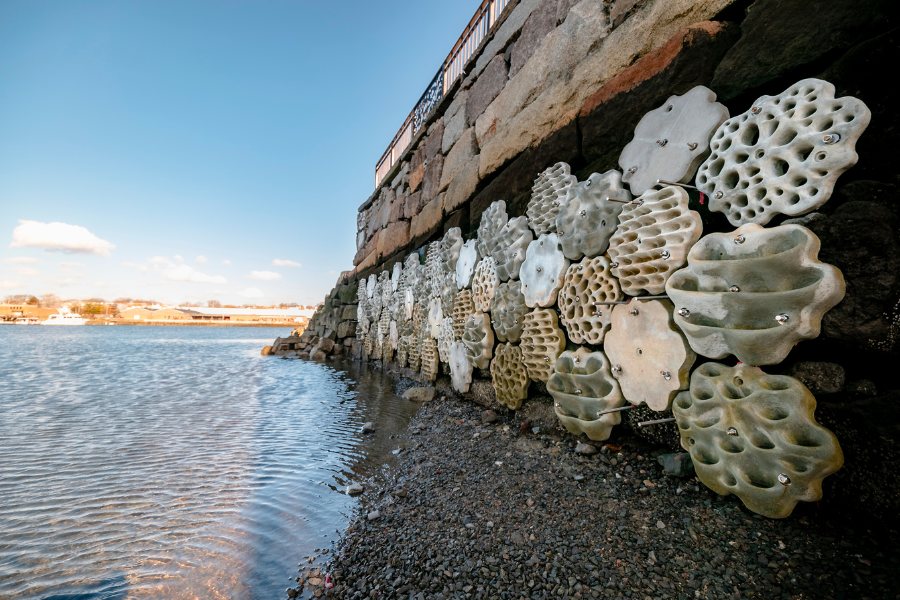
Perhaps most visible is the lab’s work with Living Seawalls, a technology for retrofitting lifeless coastal infrastructure to create thriving artificial reefs. After being named a finalist for the prestigious Earthshot Prize in 2021 at a ceremony hosted in Boston, the Australia-based Living Seawalls team, led by internation-ally respected environmental scientist Katherine Dafforn, worked with the lab to install Living Seawalls in two Boston Harbor locations. The seawalls have received extensive media coverage and inspired exhibits at the Museum of Science and Boston Children’s Museum.
The collaboration also led UMass Boston to hire Dafforn in January 2025 as a distinguished professor of coastal resilience and director of the Stone Living Lab, a move that Plesset calls “a real win for the lab and for UMass Boston.”
At a critical time in climate research, “this new level of funding from the Stone Foundation is transformational,” said Dafforn. Increased resources for construction and staffing will enable the lab to “tackle bigger ideas at a much larger scale.” And the grant’s five-year timeframe gives the lab time to conduct robust monitoring to evaluate whether approaches are truly effective.
The lab also plans to expand collaboration with UMass Boston’s Sustainable Solutions Lab and take on more graduate students, increasing capacity for research and outreach and building the pipeline for the region’s resilience workforce.
“Thanks to the Stone Foundation’s generous support for the Stone Living Lab, we now have an exciting opportunity to continue expanding, exploring, implementing, and sharing climate solutions with communities here and around the world,” said UMass Boston Chancellor Marcelo Suárez-Orozco. “UMass Boston is proud to deepen this effort and, as an internationally recognized leader in climate resilience work, we remain dedicated to helping our students at the Stone Living Lab develop a toolbox of innovative, evidence-based, and nature-inspired resilience solutions for Boston and beyond.”
The Stone Foundation is confident that the lab’s work over the next five years can establish nature-based approaches as research-tested best practices for cities coping with climate change.
“We have everything in place to deliver results and approaches that can help the world deal with this existential challenge. UMass Boston is committed to that, and we have high hopes,” said Cathy Stone. “The Stone Living Lab brings many people together to work toward solutions that will help our region and the planet live more sustainably in the future. It is a model that can give inspiration and hope to everyone.”