Pushing the Sport Forward
Bob Hall '74 helped transform wheelchair racing from a niche pursuit into a recognized competitive sport, opening the road for generations of athletes to follow.
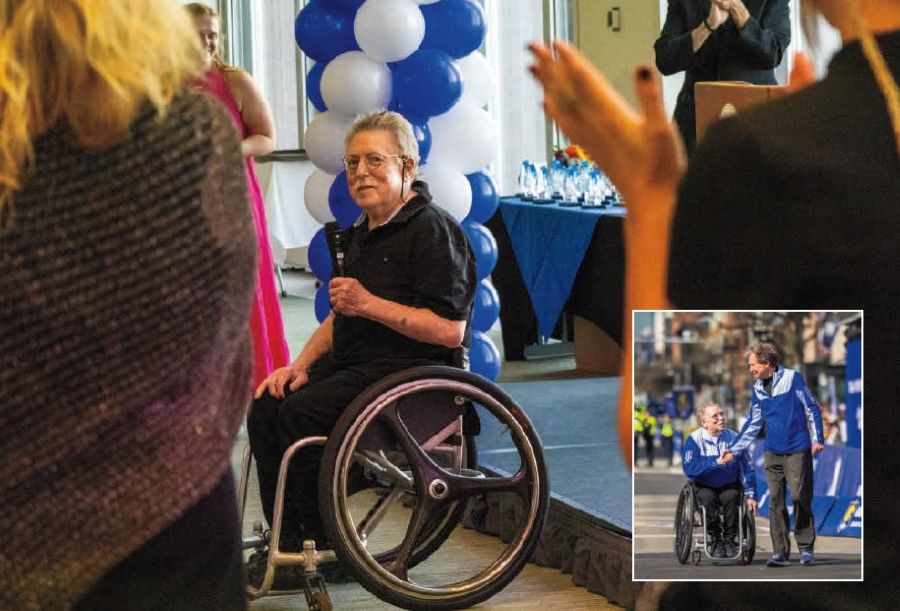
On his way to becoming the “father of wheelchair racing,” Bob Hall ’74 had a key ally from back in his days on the college track team—the legendary track coach Bill Squires.
"Squires saw something that probably we didn't see: that Bobby was an athlete, even though he was in a wheelchair,” recalled Mike Duggan ’77, a teammate of Hall’s who would watch Squires and Hall practice before the rest of the team hit the track. “He worked as hard as anybody.”
Hall, who died in Cambridge in April at the age of 74, became perhaps the most important figure in wheelchair racing starting in the mid-’70s, bringing both visibility and structure to the nascent sport.
Training with the track team of Boston State College (which was later incorporated into UMass Boston), Hall had to tape his hands and muscle his way forward in a heavy, hospital-style wheelchair that weighed close to 30 pounds. And there weren’t many opportunities to race; Duggan recalls Squires finding a one-mile wheelchair race for Hall to compete in.
From those challenging early days, Hall became the first wheelchair champion of the Boston Marathon, in 1975; successfully lobbied marathons to create wheelchair divisions; and started his own company, Hall’s Wheels, which helped lead the way in manufacturing ultralight wheelchairs that mark the sport today.
In short, he was a trailblazer in making the sport more inclusive.
“In any realm of pioneering, there can only be one first, and in wheelchair road racing that remarkable distinction belongs to Bob,” says Jack Fleming, president and chief executive of the Boston Athletic Association, which hosts the Boston Marathon. “He had a vision, and he trained to be the first.”
Navigating an old campus
Hall, who was born in Cambridge in 1951, contracted polio as a baby, permanently affecting his right leg. His time at Boston State College was years before passage of the 1990 Americans with Disabilities Act, so he had to navigate the campus with the aid of a crutch, Duggan recalls.
“When Bobby and I went there, the halls were narrow, and I never saw him in a wheelchair around the campus,” he said. “Because it was really 22 or 23 buildings together, and he would use one crutch, and that’s how he would get along.”
Duggan remembers playing on an intramural basketball team with Hall, who ditched the crutch for the games.
“I mean, he couldn’t run up and down the court like everybody else was running, speed-wise, but he figured out a way to come up and down the court without falling. He was a good shooter,” Duggan said.
Making history at the Boston Marathon
Under Coach Squire’s tutelage, Hall in 1974 won the first national wheelchair marathon in Toledo, Ohio. Then he set his sights on something bigger: the iconic Boston Marathon. In 1970, a Vietnam War veteran named Eugene Roberts had been the first wheelchair competitor in the race, but he wasn’t officially recognized. Roberts took seven hours to finish the course.
The race director, Will Cloney, told Hall that to be recognized he would have to finish in under three hours. As Hall later told the Boston Globe, “Will said that if I finished the race in under three hours, he’d give me the same certificate of accomplishment that he gives every runner who breaks three hours.”
Hall completed the race in two hours and fifty-eight minutes, earning the distinction of the first sanctioned wheelchair racer in the Boston Marathon. The wheelchair weighed 27 pounds, about double the weight of today’s racing wheelchairs.
“If you go to a hospital today and you go into the emergency room and they put you in a wheelchair, that’s the wheelchair that he was racing in,” Duggan recalled. “It was just remarkable that somebody could do a marathon in three hours with that.”
In 1977, when the Boston Marathon included seven wheelchair racers, Hall came in first place in the group, finishing in just over two hours and forty minutes.
"All of us face limitations of one sort or another,” Hall reflected in a Boston Marathon documentary. “The real gauge of a man is whether or not he approaches his full potential.”
Paving the way for others
Hall’s barrier-breaking work paved the way for thousands of wheelchair racers, including nearly 2,000 competitors in the Boston Marathon alone over the years. And his impact was not limited to the racecourse.
He worked with an oceanographic engineer to design and build racing wheelchairs for his company, Hall’s Wheels. A 1986 model was included in a 1989 exhibit, Designs for Independent Living, at the Museum of Modern Art in New York; it remains in the museum’s permanent collection. The museum website notes the model “features a lightweight frame of aircraft-steel tubing, a speedometer, and a tachometer.”
Marcel Hug, who won his ninth Boston Marathon this year in just over one hour and sixteen minutes, raced early in his career in a wheelchair designed by Hall.
“I had the honor to meet Bob Hall and speak to him,” Hug said after winning last year’s race—50 years after Hall’s historic Boston Marathon debut. “I’m very grateful and thankful for what he did. He opened the door for us so that we can participate here. To win today at the 50-year anniversary is really something special.”
Bob Hall’s dedication changed the course of wheelchair racing, leaving a legacy that extends beyond records and equipment design. He reimagined who can compete in races, and through a combination of will and innovation, made athletics more inclusive for everyone.