UMass Boston Hosts Conference on Ethics and the Future of AI
The conference, which took place in partnership with the Pontifical Academy of Social Sciences and the Latin American AI Network for Integral Human Development, welcomed AI experts from around the world.
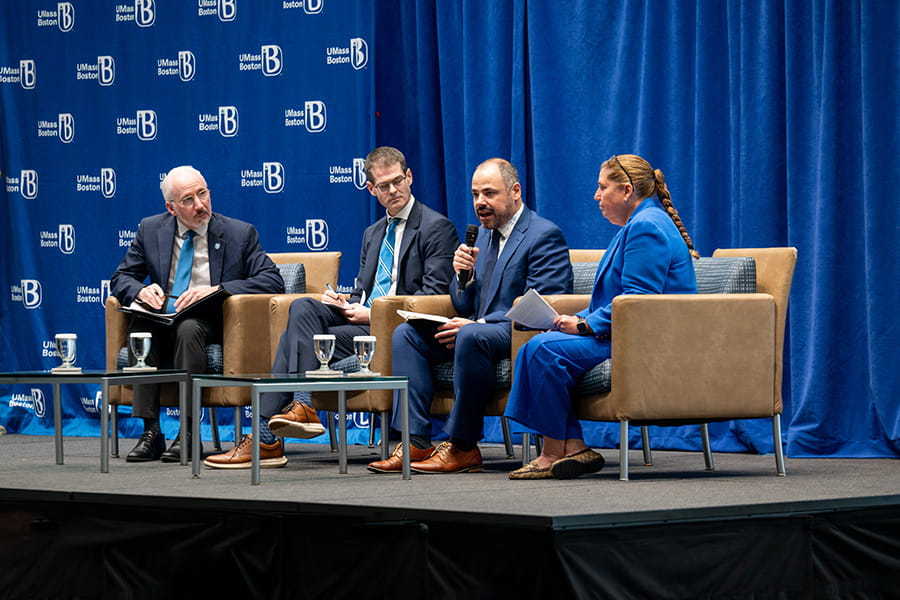
On October 27, UMass Boston hosted a day-long conference on the future of AI and how it can be used responsibly. As experts in economics, politics, education and cybersecurity gathered in the Campus Center ballroom, UMass Boston’s chancellor, Marcelo Suárez-Orozco, took the podium to introduce the event.
“Tech moguls, the high viziers of our civilization, tell us that someday work will be unnecessary, and AI will do everything for us. Enough magical realism,” Suárez-Orozco said emphatically. Like any tool, he suggested, AI promises both benefits and dangers, depending on how it is used. “The issue isn’t AI itself, the issue is us.”
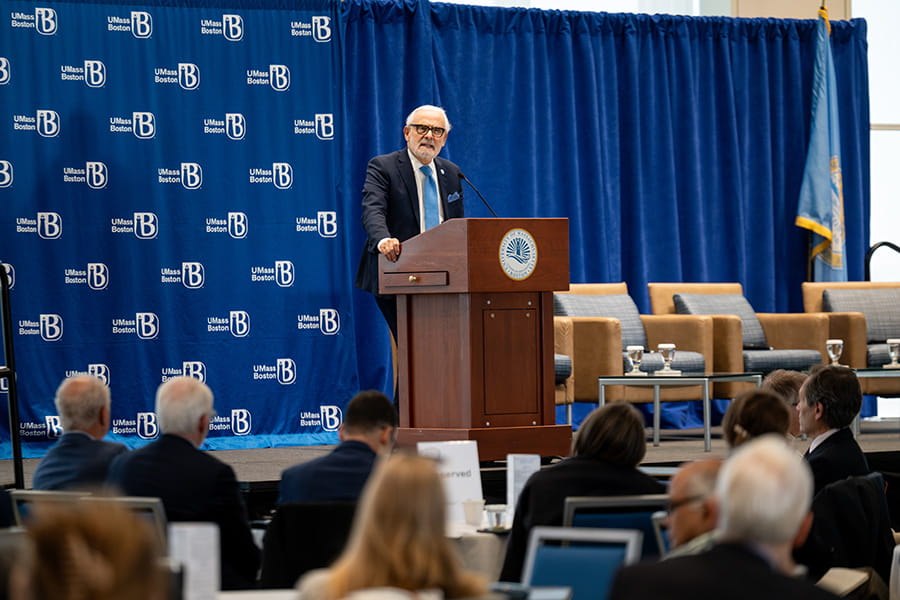
Chancellor Suárez-Orozco delivers his opening remarks. Photo by Kaitlin Prince.
The importance of responsibility in AI usage surfaced in every discussion. To begin, UMass Boston’s provost, Joseph Berger, led a panel on AI in education. The panelists grappled with the tension between making sure students get the AI literacy they will need, while also preventing them from stunting their own education with overreliance on AI.
As concerned parents come up to ask questions following the panel, the experts reiterated that teachers must keep children’s best interests in mind. “I think AI should be used in a purpose-driven way,” said Garrett Smith, deputy secretary of Massachusetts’ executive office of education. “We should not give in to the ‘shiny penny’ syndrome, right? There's all this energy, there's all this excitement, there's all this possibility, but we need to be really thoughtful.”
Other panelists suggested that such caution and transparency could help the public slowly come to trust AI over time. The AI and Governance panel agreed that governments need to show, in concrete ways, how their new AI tools are being used to solve actual problems. On the AI in Healthcare panel, participants discussed the consequences when the public loses confidence in authorities, including AI, and compared it to the chaos and division of the COVID-19 pandemic.
The AI in the Workforce panel addressed some of the anxieties of workers, and future workers, as they confront the realities of how AI is affecting the workplace. Wei Ding, the executive director of the Paul English AI Institute, pointed that students are graduating into a world where the jobs they prepared for may no longer exist. However, there will be different jobs, ones where AI assists humans rather than supplanting them. “The human must be in charge and be the one to harness AI,” she said. “They must be the one with the final say.”
The panelists on AI in Innovation echoed this sentiment. Stephanie Chiras, the senior vice president of the AI Innovation Club at Red Hat, suggested that for students, “now is the time to pick something you are passionate about, because if you love it, you will learn how to critically look at it. AI will come in as an aide for everything, but it cannot teach passion.”
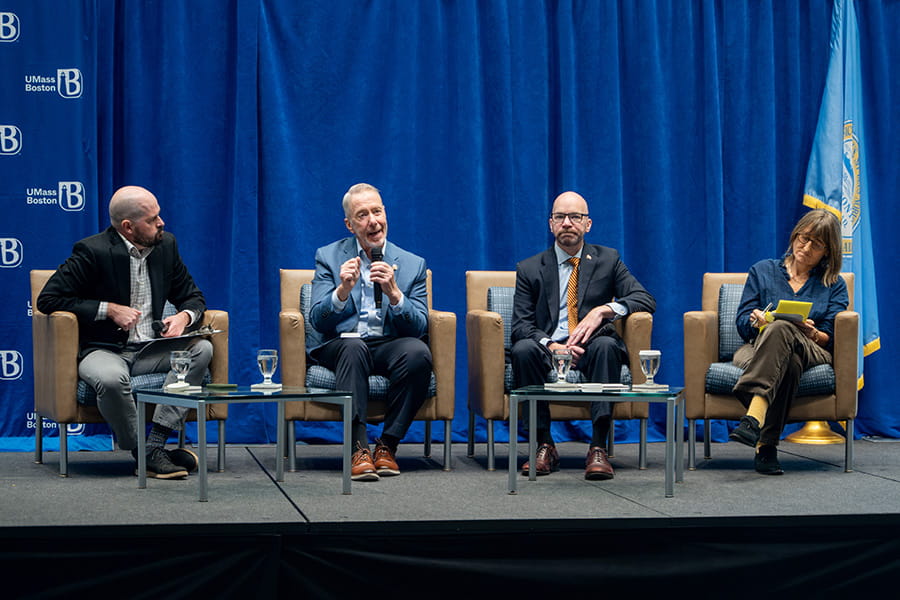
Panelists on the AI in Democracy panel considered how governments and legal institutions can grapple with the challenges and promise of AI. Photo by Kaitlin Prince.
Many panelists stressed that this AI-saturated future is not inevitable. The AI in Democracy and AI in the Administration of Justice discussions offered a glimpse into how, through existing laws and structures, governments can regulate the use of AI, rather than allowing it to become primarily the tool of fraudsters and criminals. Congressman Stephen Lynch raised the specter of the damage that could be done by a rogue superintelligence, while the Baroness Beeban Kidron said that, by holding AI companies responsible for their creations’ actions, there are paths forward to a world where AI can be used in healthier, more considered ways.
The conference concluded on a note of cautious optimism. There is hope for the future, but only if users and regulators of AI make a concerted effort to guide its use in a positive direction. AI has the potential to help the poor, reduce inequality, and solve critical scientific problems, but doing so will require hard work, rather than simple surrender to the technology that, as Gustavo Beliz, member of the Pontifical Academy of Social Sciences said, said has the power to “invade our minds through addictive design, destroy our attention, and manipulate our emotions and our genes.”