UMass Boston Offers AI Education Microcredential Program
The Paul English Applied Artificial Intelligence Institute aims to offer students from UMass Boston and the surrounding community a chance to learn about new AI tools with a flexible, adaptable program.
As AI grows more powerful and commonplace, students are finding that their potential employers are looking for candidates with proven AI expertise. At UMass Boston, the Paul English Applied Artificial Intelligence Institute (PEAAII) offers a solution: Through short-term classes, events, and contests, students at the university and its surrounding communities can earn an AI microcredential.
The AI microcredential program was put in place in 2025, following a recommendation by UMass Boston’s provost, Joseph Berger. It also has the support of Paul English ’87, G’89, H’19, a philanthropist and tech entrepreneur who first conceived of the institute and contributed $5 million to establish it.
“We want our students and community members to understand both the possibilities and responsibilities that come with using AI,” said Berger. “These microcredentials give participants an opportunity to develop practical AI skills they can apply thoughtfully and ethically in their fields, whether they are pursuing a new idea, advancing their work, or exploring a new career path.”
This is not the only microcredential program at UMass Boston—for instance, students interested in biomedical sciences can pursue a Drug Development and Clinical Trials microcredential—but a microcredential program is particularly well-suited for flourishing new fields, like AI studies.
“AI is evolving much faster than traditional academic programs can be developed. Microcredentials give us the flexibility to respond quickly, expand access, and help students and community members build practical AI skills that remain relevant as the technology changes,” said Wei Ding, distinguished professor of computer science at UMass Boston and the executive director of the Paul English Applied AI Institute.
Currently, several programs can qualify UMass Boston students for an AI microcredential. These courses and events are primarily designed to require a minimum of prior experience with AI, allowing students from a wide variety of backgrounds to take part. For example, PEAAII’s annual hackathon and symposium offers an exciting chance for students to solve real-world problems using AI.
This year, during the third annual hackathon, participating students will be able to form teams, create a useful AI project, receive feedback on their work, then present it as part of an award ceremony and showcase. Students who successfully complete the AI Contest and the AI Application Hackathon are eligible for a microcredential in applied artificial intelligence.
Tina Chang, UMass Boston’s assistant provost of community and executive education, stresses that events like these are an important part of students’ preparation for their careers. “As a public research university in one of the world’s great centers of innovation, UMass Boston is uniquely positioned to bring together education, research, industry, government, and communities around a shared vision for responsible and ethical AI,” she said. “We can help ensure that the future of AI is not something that simply happens to us, but something we help shape together.”
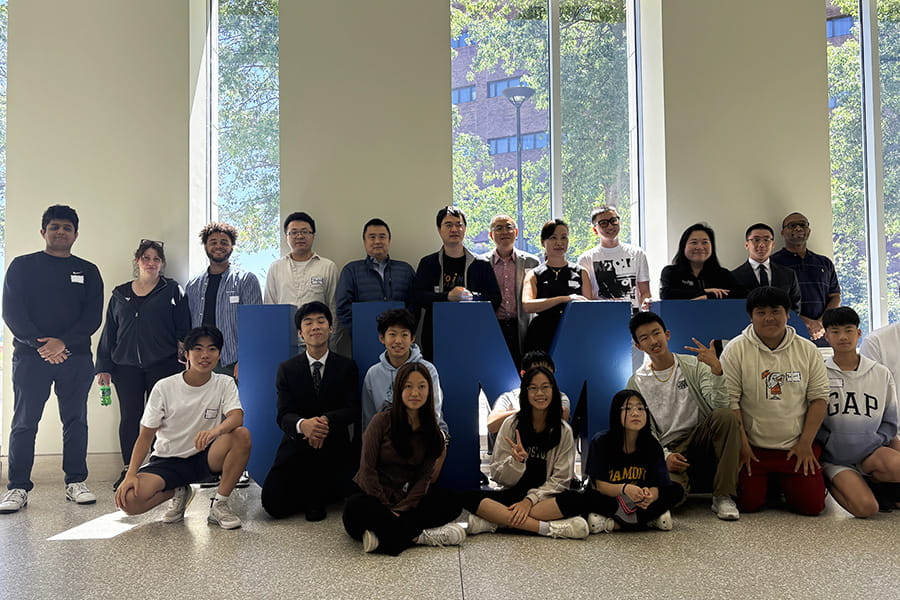
This community-driven approach means that AI microcredentials aren’t limited to UMass Boston students. This year, in an expansion of a pilot program offered last year, PEAAII opened its doors to high schoolers for an AI Institute Summer Camp. Over the course of this five-week flexible program, students dove into the underpinnings of machine learning, how AI can be integrated with hardware to interact with the physical world, how large language models work, and many other topics.
After they return to school, these young students will still need AI-literate teachers. On July 31, PEAAII offered a one-day AI literacy training workshop for high school teachers in the Boston public school system. The event was part of a new public-private partnership between Boston Public Schools and UMass Boston, which will boost AI literacy for students across the district. With a deeper knowledge of AI’s capabilities, teachers can be better prepared to help students use AI responsibly and ethically. The training culminated in a collaboration between the teachers and the high school students, which led to an open-source co-publication.
“Our goal is to prepare students not simply to use AI, but to apply it responsibly and effectively in their education, careers, and communities,” Ding said. “Through these programs, we are creating accessible pathways for people from different backgrounds to develop practical AI skills and participate in the opportunities AI is creating.”