UMass Boston Professor Will Be ASLO’s Next President-Elect
Robert Chen, professor and director of Grand Scholarly Initiatives will serve as president-elect of the Association of the Sciences of Limnology and Oceanography (ASLO) for two years before becoming president.
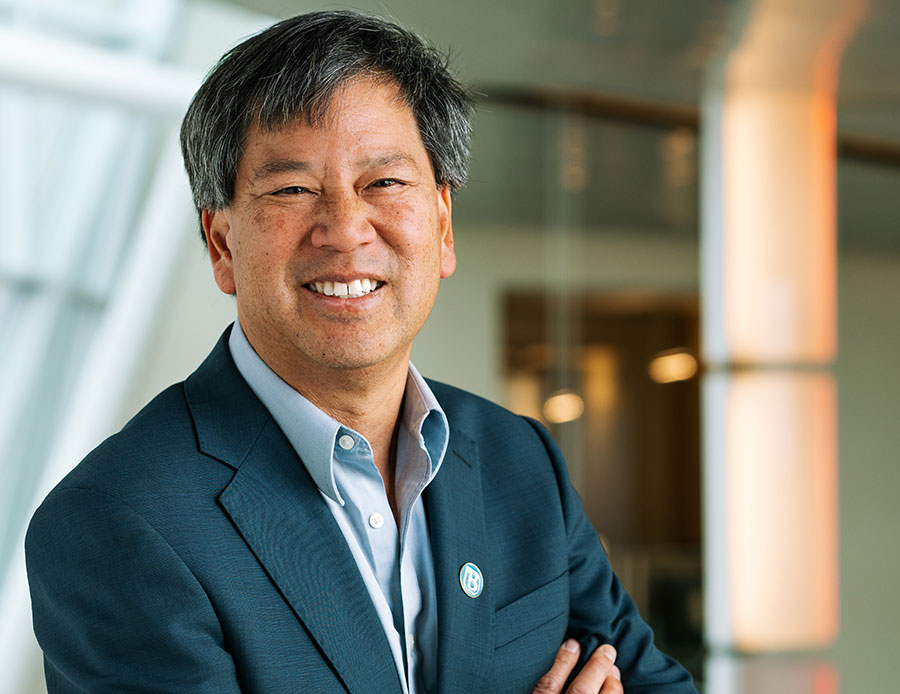
Earlier this year, Robert (Bob) Chen was elected to ASLO’s highest leadership position. To maintain continuity within ASLO’s leaders, Chen will begin by serving a two-year term as president-elect. In 2028, he will become president, and in 2030 he will take on the role of past president.
Chen has long considered ASLO to be his “professional home,” and taking on the presidency is a natural progression of his commitment. He served on the ASLO Board from 2016 to 2022. He was the co-chair of the biennial Ocean Sciences Meeting in 2020, and served as Chair in 2022. He has contributed to ASLO’s journals, serving as an associate editor of Limnology and Oceanography: Methods since 2019.
Chen’s work at ASLO built upon his responsibilities at UMass Boston, and vice versa, as he progressed through his career: “By the time I stepped up to become the interim dean of the School for the Environment, I had a lot of experience with leadership at various levels,” Chen said. “You can manage a funded project, and you can lead a lab group, but this was on a larger scale. Serving on the board of ASLO and managing large grants helped prepare me for the next role.”
Being an educational leader, both at UMass Boston and ASLO, has always been important to Chen. Since 2010, he has served as chair of the ASLO Education and Engagement Committee, which has developed a suite of high-quality educational materials for ASLO members to use and established programs such as the Global Outreach Initiative and ASLO Storytellers. Chen looks back on his early days at the committee with pride: “Being the chair of the committee was one of my first leadership roles…, and while there are some committees that don’t do much, we did a lot! The committee has a very healthy membership because members find value in the meetings that we have.”
Two years ago, Chen was awarded the Ramón Margalef Award for Excellence in Education, which recognized the impact he has had on young scientists. Chen has devoted much of his career to ensuring that aspiring researchers have access to the education and mentorship that they need. Through his work on “K-to-gray” educational programming, he has designed courses for toddlers and older adults alike, and he has provided professional development training to more than 600 science teachers while being the principal investigator of the NSF-funded of the Boston Science Partnership.
Since he first joined ASLO several decades ago, Chen has seen the society go through many changes. Back then, as Chen recollects, “Ocean science was mostly focused on blue water oceanography. I came to UMass Boston in 1992 to work on the urban, coastal ocean, because the Boston Harbor really affected people—it was dirty and needed cleaning up. I was one of the first of a new wave of urban oceanographers.”
Over the years, he says, ASLO’s membership has shifted its focus, and become more dynamic: Researchers are focusing more on coasts, watersheds, and the people who live there. New ways of doing science including incorporating indigenous knowledge are being recognized and valued. The membership of ASLO itself is diversifying and becoming more inclusive.
All these trends, Chen says, are a boon to the society but also pose new challenges, as new members have different needs. As much as Chen enjoys the annual ASLO meetings—he’s attended more than 35 of them—he hopes to find ways for members to engage with each other and with the society outside of those meetings. He acknowledges that, for some members, meeting in-person is not feasible, requiring “too much investment in time, funds, and CO2.”
Chen hopes that during his tenure, ASLO will become even more dynamic and inclusive, helping its members to thrive in a rapidly evolving world. Whether that means exploring new ways for communicating scientific findings, adapting to the proliferation of AI tools, or offering more opportunities to aspiring young researchers, Chen is excited to contribute to ASLO’s future.