Where Art Belongs
A 30th anniversary gallery exhibition celebrates Arts on the Point -- the visionary public art initiative founded by Professor Emeritus Paul Tucker -- while honoring the work of students, artists, and advocates carrying its legacy forward.
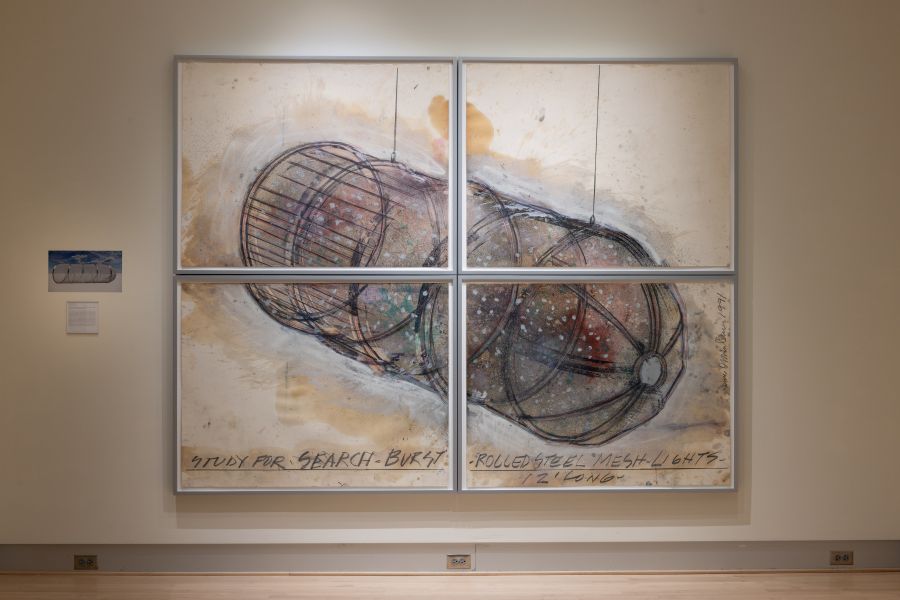
Like many grand quests, the journey that led to the momentous and scholarly gallery exhibition celebrating three decades of Arts on the Point began with a treasure map. Or more specifically in this case: a binder.
“It had been floating around the department for years and eventually made its way to the gallery,” said Isabella Slonka ’26, the University Hall Gallery curatorial assistant who researched and curated the exhibit. Her training from her Honors College history courses had already given her a keen eye for deciphering relevance and discerning stories that had yet to be told. The binder’s colorful tabs held names of luminary artists—Oppenheim, di Suvero, Jimenez, and others—who had lent their timeless works to Arts on the Point, the arts initiative founded in 1997 by Professor Emeritus Paul Tucker that brought largescale sculpture to UMass Boston’s Columbia Point campus.
“I’d heard a lot of memories and little bits and pieces about Arts on the Point, but there was very little writing on it, Slonka recalled. “In history, you’re always looking for a gap in the literature. And this was the Grand Canyon. Nobody had touched this, and I needed to jump on it.” Drawing from her extensive research, including Tucker’s papers in the Healey Library Archives and Special Collections, Slonka began reconstructing a history that had long lived in fragments.
The outcome of her curiosity and dedication was Arts on the Point: Celebrating 30 Years, a multimedia retrospective offering the most comprehensive framing of the initiative to date and the first time the gallery has mounted a student-led archive-based exhibition of its scale. The collection not only highlighted the important names and installation dates of Arts on the Point, but it also helped uncover the social texture around it: the changes on campus, the surrounding community, and the students, artists, donors, and staff who helped make the initiative possible.
On April 9, 2026, more than 100 attendees gathered for the public reception. Among the celebrants who explored the sunlit gallery were returning artists Sheila Pepe (who created a new piece for the installation), Clara Wainwright, and of course, Professor Emeritus Paul Tucker, whose visionary work established the public arts initiative that made UMass Boston an important convener and steward of the arts.
“The arts have often traditionally been associated with a certain sector of culture and society that is not always a part of a public space, and particularly not about public educational space,” Tucker said, reflecting on his motivation for establishing the program. “But the arts are essential to all of us, and in a public space or a public university, having access and proximity to actual works only enhances the notion that we all are in this together.”
For Tucker, the purpose was always clear: A public university deserves public art. The sculptures on campus were not passive objects; they were provocations that invited students, faculty staff, and visitors to ask questions, to pause in familiar spaces, and to encounter and engage with art as part of daily life.
This principle continues to guide the program’s next chapter Sam Toabe, who serves as director of both University Hall Gallery and Arts on the Point, sees the 30th anniversary as a time to honor Tucker’s legacy and craft the expansion of the program’s impact going forward.
“There is a big conversation happening right now reorienting art as a very crucial part of civic life, creative thinking, and problem solving,” said Toabe. “We want to utilize public art as a way of engaging our students and communities across all different academic fields to get them to think more critically about our past, present, and future.”
That future is already unfolding, with recent and upcoming Arts on the Point projects that build on Tucker’s founding vision of monumental sculptures to include performance art, interactive experiences, and murals. Through partnerships connected to the Boston Public Art Triennial, students have participated in fabrication, programming, and workshops. Toabe also hopes to restore major works, bring new artists to campus, and continue positioning UMass Boston as a leader in public art access and discourse. The work ahead will include conservation, new commissions, and renewed philanthropic support. But the heart of the initiative will remain remarkably consistent: that art belongs to the people, in public view, on the campus of a public university shaped by beauty, complexity, and possibility.
"A public university deserves public art." - Professor Emeritus Paul Tucker
Curated by University Hall Gallery curatorial assistant Isabella Slonka ’26 as a part of her Honors College senior thesis project, Arts on the Point: Celebrating 30 Years celebrated the revolving public art initiative that has brought major works of contemporary sculpture to UMass Boston since 1997. Through the leadership of Professor Emeritus Paul Tucker, internationally recognized artists, including Sol LeWitt, Roy Lichtenstein, Willem de Kooning, Dennis Oppenheim, Luis Jimenez, Sheila Pepe, Bill Tucker, and Mark di Suvero, lent works to the university, installed them on campus, and, in many cases, met directly with students. The program raised more than $1 million in private philanthropic support, helping make large-scale public art part of the everyday environment of a public urban university.
On the walls and throughout the gallery were archival photographs, sketches, smaller scale works, and materials from Tucker’s papers and archival collection, accompanied by Slonka’s in-depth research and interviews. Together, they told the story of an ambitious public arts initiative that transformed UMass Boston’s harbor front campus into a sculpture park and positioned Columbia Point as an important site in Boston’s public art landscape.
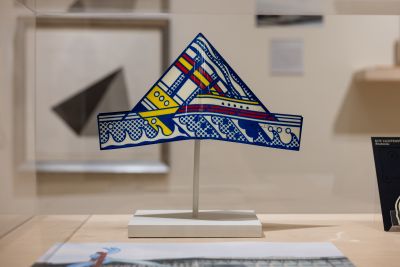
Roy Lichtenstein Folded Hat, 1968 sculpture: lithograph: folded paper print Courtesy of a private collection, New York. Image by Olivia Moon Photography.
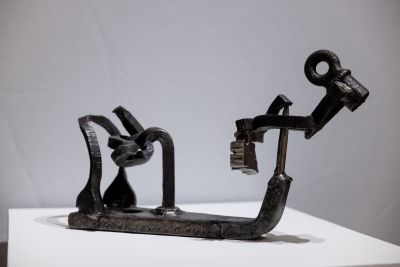
Mark di Suvero Hieroglyph, 1976–2009 steel, stainless steel Courtesy of the artist and Paula Cooper Gallery. Image by Olivia Moon Photography.