“Bright Beacons” Program Expands On-Site Solar Power Generation at UMass Boston
New photovoltaic panels on campus rooftops will generate renewable energy to power UMass Boston’s buildings.
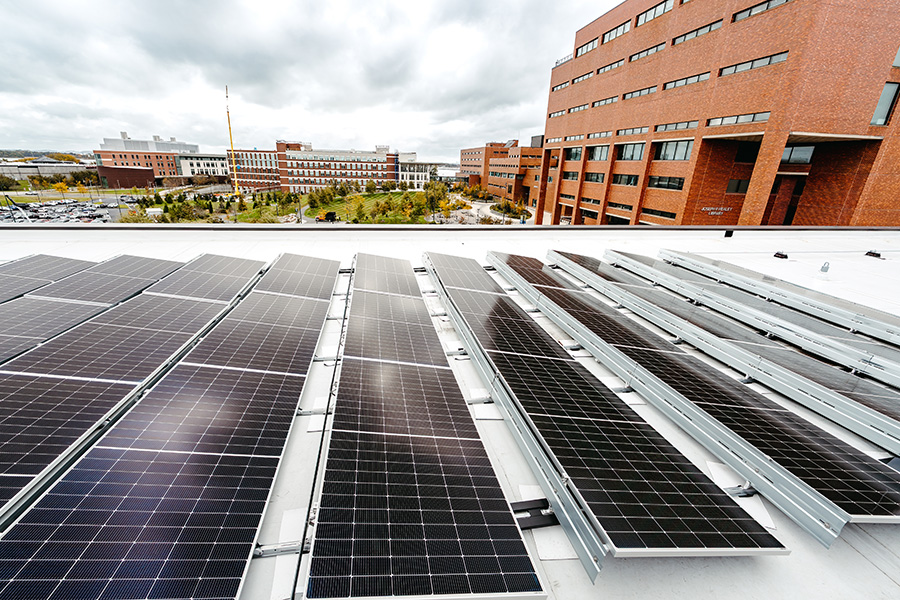
On the roof of the Quinn Administrative Building, a new set of solar photovoltaic (PV) panels gleams in the November sun. The panels, installed earlier this year, are part of the “Bright Beacons Solar Project,” which will place this clean renewable power source on many of UMass Boston’s rooftops.
The UMass Boston campus already hosts photovoltaic panels on several buildings, including University Hall and the West Parking Garage. In addition to the Quinn Administrative Building, panels are currently being installed atop McCormack Hall. The Bright Beacons Project also includes plans to place panels on top of the Campus Center following roof repair work in 2027.
The new panels almost double UMass Boston’s current renewable electricity output, by generating approximately 2,000 MWh in total annually—enough to power the needs of 280 average homes for a year. All together, these solar projects will power approximately 4.5% of the campus’s total electricity needs, reducing the power that UMass Boston draws from the electrical grid that is already overburdened.
“We’re really ramping up our solar power generation for a number of reasons,” said Mike Kearns, the associate vice chancellor for facilities at UMass Boston. “The state has set a goal that by 2050, our fossil fuel emissions be reduced by 95% of 2004 levels. That has encouraged us to implement a number of clean energy projects.”
The panels are also a sound financial decision. The university also received a grant from the Massachusetts Department of Energy Resources’ “Leading By Example” program, and additional support is being provided by federal tax credits that were newly available to non-profits like UMass Boston when the project was contracted. Once these are taken into account, the panels should pay for themselves in roughly four years.
Solect Energy has begun installing the McCormack Hall panels. The Campus Center will receive its first panels once the building’s new roof is completed.
On-campus solar power generation capacity was identified as part of UMass Boston’s Energy and Carbon Master Plan, which was first published in 2023. Through the new photovoltaic panels, a new seawater-based heat-shift chiller system that will replace three natural gas boilers, and many upgrades that will improve energy efficiency, UMass Boston is building a more sustainable campus through renewable energy. The university is also decarbonizing its energy sources significantly, reducing carbon emissions and contributing to the fight against global warming.
“The Bright Beacons project is a vital step in making UMass Boston a more climate resilient campus,” said Janna Cohen-Rosenthal, UMass Boston’s sustainability and resiliency planner. “As a university, we use a lot of energy to provide critical education and research. By having renewable energy sources here on campus, we’re able to showcase solutions for our students while also lowering energy costs and reduce our reliance on fossil fuels.”
For those who are interested in learning more about solar energy and decarbonization efforts, the Office of Campus Planning and Sustainability offers tours of the UMass Boston campus for student clubs, classes, and other groups. These guided walks, led by Cohen-Rosenthal and her student sustainability assistants, highlight UMass Boston’s unique sustainability adaptations, both new and old.