Call for Civic Moral Integrity at Wood Visiting Professorship Lecture
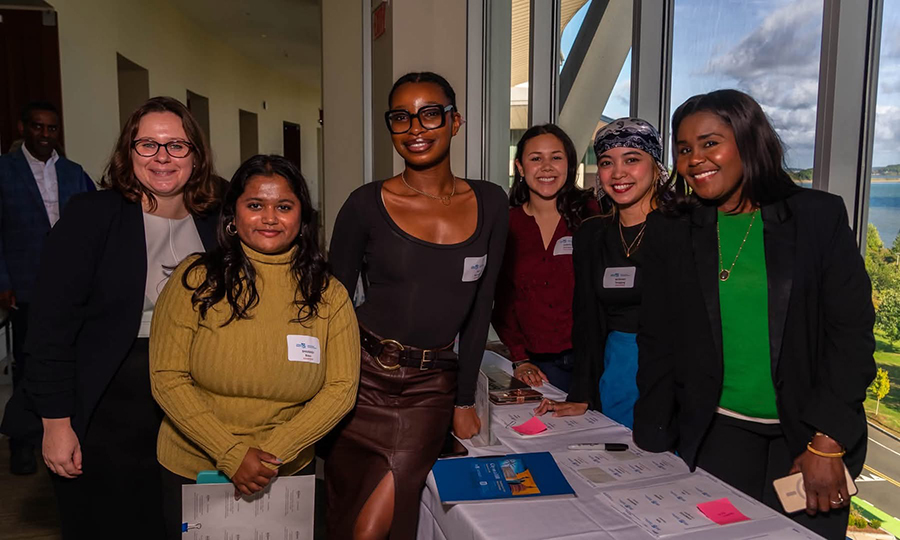
On September 23, 2026, the John W. McCormack Graduate School of Policy and Global Studies at UMass Boston convened its 28th Robert C. Wood Visiting Professorship lecture, "City on a Hill: Resetting Our Civic Moral Compass."
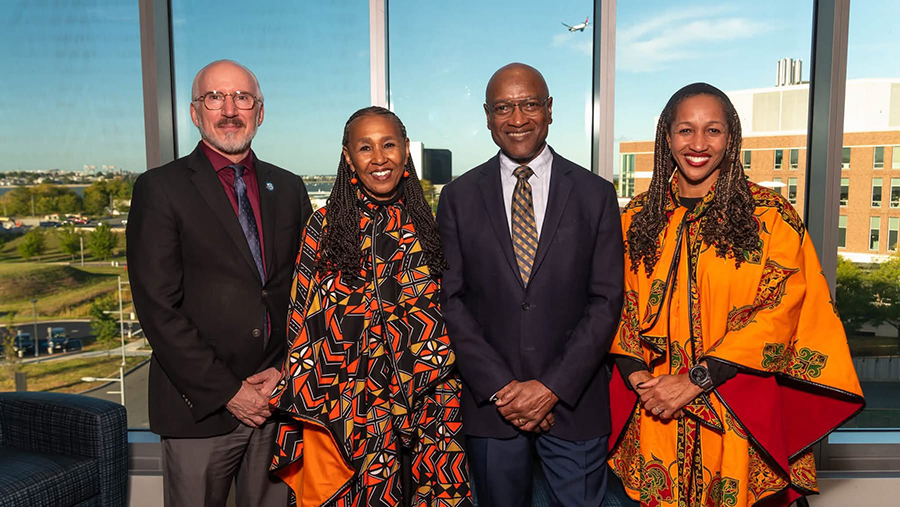
Attendees gathered at both the Campus Center and online to hear from this year’s honorees: Rev. Dr. Ray Hammond, Rev. Dr. Gloria White-Hammond, and their daughter Rev. Mariama White-Hammond, who shared ethical beliefs and values cultivated as a family, as community and public leaders, and as founders and pastors of African Methodist Episcopal (AME) churches.
In their first-ever public conversation as a family, the three Wood Visiting Professors issued a call for more robust civic moral integrity to better confront a host of challenges affecting Boston and beyond. Building this integrity relies on “right relationships,” they said, because one’s principles are not developed in isolation, but in the practice of daily living. “Your big values show up in bite-sized ways,” Rev. Mariama told the assembly. “They’re like a muscle. When not used regularly, it atrophies.”
Established in 1996 with the public launch event occurring in 1998, the endowed Wood Visiting Professorship honors the life and legacy of Bob Wood (1923–2005), a prominent public intellectual and practitioner who moved through nearly every level of American politics and government as professor, scholar, federal budget examiner, presidential adviser, HUD's first undersecretary and briefly its secretary, MBTA chairman, UMass president, and Boston Public Schools superintendent during court-ordered desegregation.
In her opening remarks, Dr. Christa Kelleher, this year’s chair of the Wood Committee, said that the committee determined that the 2026 program called for “something different, something bold, akin to a family dinner conversation,” due to “the gravity of existing threats to our democracy, our society, our earth, and our very humanity.” In the face of existential peril, “what’s needed is civic moral leadership,” she said. What better place to look than to three local faith leaders, each with a lifetime of morally centered integrity and public leadership, in the spirit of Dr. Wood’s life and legacy. In keeping with Dr. Wood’s career as a scholar practitioner, reading lists were curated to address various dimensions of this year’s Wood theme. Finally, four large poster boards chronicling key facets of Dr. Wood’s professional life were on display, showing not just accomplishments but application to problems beleaguering our society and democracy today.
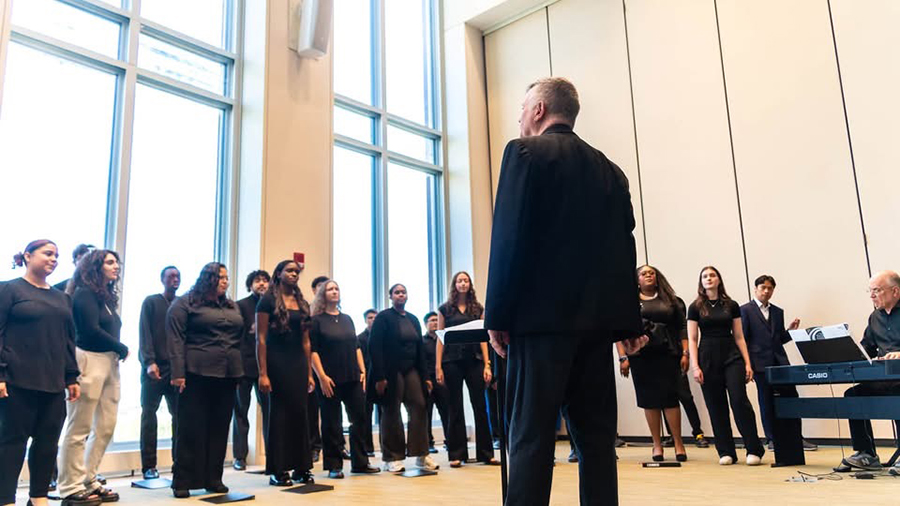
Preceding the panel discussion, two musical selections were performed by UMass Boston’s Chamber Singers in memory of Margaret "Peggy" Wood, the late Dr. Wood’s widow, a longtime member of the planning committee, who passed away on March 4, 2026.
Critical life decisions
As the three Wood recipients shared their stories, they described certain turning points. Pastor Ray and Pastor Gloria first met and married while in medical school, then pivoted together towards a pastoral calling in 1988 when they co-founded Bethel AME Church in their Jamaica Plain living room. Pastor Ray reflected upon his time as an emergency room physician treating young people injured by violence, stating, “They needed something that I couldn’t give them as a doctor.” Pastor Gloria said she, too, was “called to a ministry of healing,” and, early on, served a similar community as a pediatrician at the South End Community Health Center. She also founded “Do the Write Thing,” a creative writing ministry for girls, and My Sister’s Keeper, bringing her community organizing passion from Boston to Sudan, while Pastor Ray served in leadership roles addressing gang violence as chairman and co-founder of Boston’s Ten Point Coalition and as a trustee of organizations including The Boston Foundation, Greater Boston Interfaith Organization (GBIO), the Boston Symphony Orchestra, and The Boston Globe. Both Pastor Ray’s and Pastor Gloria’s decades of service to the greater Boston community also have been recognized through honorary degrees. They both have served as faculty members at Harvard Divinity School as Swartz Practitioners in Residence.
One of Pastor Ray and Pastor Gloria’s daughters, Rev. Mariama White-Hammond, is founding pastor of New Roots African Methodist Episcopal Church in Dorchester, and previously served as Chief of Energy, Environment, and Open Space for the City of Boston. Although reared in a household of ethical discernment, Rev. Mariama White-Hammond reminded attendees that her own journey and calling also came from a deep inner resolve to develop her own moral compass. She described childhood opportunities to express it, such as the mid-1980s Coca Cola divestment campaign she joined when she was eight years old. One place to get started is to look for the tensions. “Where is the dialogue being created?” she asked, regarding the challenge of using one’s moral imagination to build “beloved community.” She reminded the audience that they don’t need to wait for permission to get going but need to “sit in the tension” while looking to history for insights.
Moderated by Dr. Michael Johnson, Professor of Public Policy and Public Affairs, and longtime Wood Committee member, the panel discussion addressed various facets of this unprecedented moment of political, civic, and personal strain. Professor Johnson asked each speaker for insights on how to cope with the moral quandaries we currently face without sliding into doomscrolling, rage, or resignation. How, he asked, do they define their moral compass?
The Wood honorees agreed that a fundamental pillar is strength of character. Pastor Ray also distinguished reputation—who you are when people are watching— from character—that is, who you are when no one’s watching—and said one’s moral compass shows itself in the choices people make when they’re "squeezed." “People reveal their real principles when they’re tested,” he said.
Pastor Gloria offered a template for navigating the moral morass, which comprises three V's: Vision, Victory, and Vigilance. She said that hard-won victories demand constant vigilance to prevent disorder from slowly reappearing. Rev. Mariama pushed back against the notion that a moral compass is self-taught, stating that it emerges through social practices that begin in the family. She also emphasized the need for humility, and for learning from those who wrestled with these questions long before us. As an example, she praised Ken Burns’s recent series on the American Revolution as exemplifying how fundamental questions of moral integrity were tackled and praised the idea of sitting in tension with the wisdom of the past and the reinvention that wisdom in the present. Pastor Gloria invoked a university's own charge to "preserve and extend knowledge," asking how we can ensure that such knowledge is carried forward from one era to the next.
Small steps, big impacts
When asked where their "right relationships" have been found, all three leaders turned toward family and community as fertile ground. Pastor Gloria described moral integrity as best cultivated in community, with accountability built first in the family and then radiating outward. As for strengthening the moral compass of our democracy, the panelists agreed we need more entry points for extending and integrating ethical values forged within personal, family, and one's immediate community spheres into public life.
As for starting points, Pastor Ray declared that how a person shows up at home is the first real test of the truth of one’s moral compass. Rev. Mariama also said that the small gestures children learn in families sow the seeds of larger commitments to public service. Pastor Ray added that adults need to sustain ongoing relationships with young people to keep their moral compass “fresh” and combat moral blindness. "Having been in the world longer, elders stop seeing what young people still notice," he cautioned.
Final remarks began with Pastor Ray’s powerful call for revitalizing civic life: that we collectively take on the task of renewing hope, upholding mutual responsibilities, and building relationships across the barriers that divide us. America, he believes, has a recurring capacity to relearn old lessons in times of anxiety and rapid change—a reckoning that resurfaces every fifty to sixty years. The question that continues to endure, he said, is just who is included in the "All" of the American covenant of “equal justice for all” and “All men are created equal." Pastor Gloria characterized this as the quest to be seen in the fullness of one's full being, beyond the multiple "isms" that our identity inspires in others. In charting the way forward, Rev. Mariama urged us to shift from frustration at the state of the world toward introspection on how we can become beacons of positive change in our communities.
The discussion concluded with audience questions, including those posed by several UMass Boston students who conversed with the trio about navigating the complexities of developing and following their moral compassion a rapidly changing world.
The convening closed with acknowledgement of Max Mian, the 2026 Wood Internship recipient who recently completed UMass Boston’s graduate program in international relations. Max’s internship project, Money, Power & the Public Interest: Cultivating Civic & Environmental Stewardship, has both immediate and long-term relevance to the 2026 Wood civic moral values theme. Envisioned and designed by Dr. Marcy Murninghan, a friend and colleague of Dr. Wood’s and the Wood family, and a McCormack Visiting Fellow in the 1980s, the internship sets the foundation for a locally based “Civic Stewardship Pilot Lab,” that introduces a model of “civic fiduciary obligation and accountability” by embedding civic moral values in the management of multi-capital resources directed to specific public equity outcomes in the overlapping policy realms of human rights, climate, and infrastructure. Those interested in joining the project are encouraged to connect with Dr. Murninghan directly through the McCormack Director’s office.