Katherine Dafforn, Director of the Stone Living Lab at UMass Boston, Named on TIME100 Next List
The annual list, which features leaders who are shaping the future, recognizes Dafforn’s role as a climate leader and a co-founder of the global Living Seawalls project.
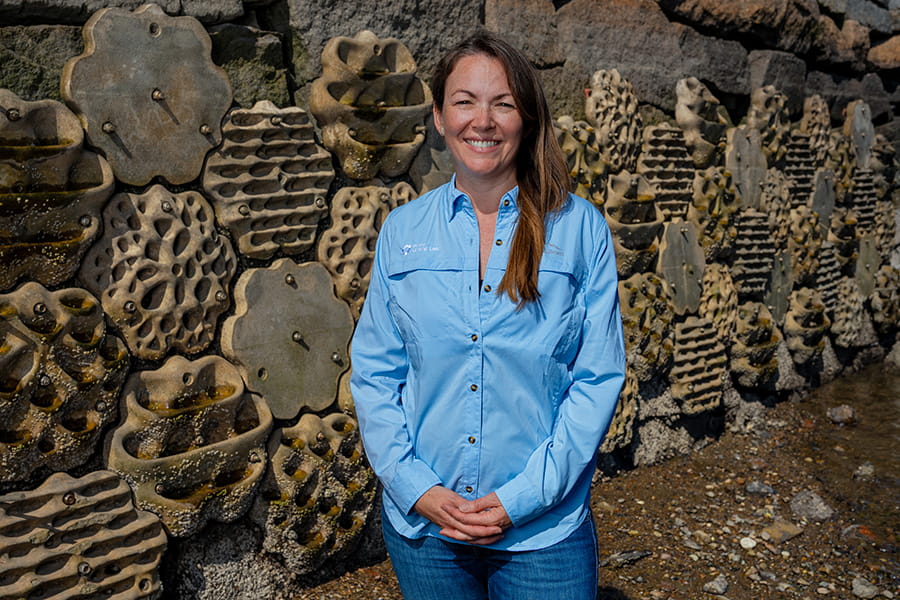
This week, TIME recognized Katherine Dafforn, a distinguished professor at UMass Boston, as one of their TIME100 Next leaders. The list, which is published annually, highlights TIME’s selection of the world’s most influential rising stars, including artists, activists, athletes, politicians, and more.
“I’m honored to have this work recognized by TIME,” said Dafforn. “Coastal communities are facing growing challenges from climate change and biodiversity loss. Building resilience is more important than ever, and we urgently need science-based approaches that help people and natural ecosystems adapt and thrive.”
Dafforn, who was nominated for this list by Boston Mayor Michelle Wu, is internationally recognized as a leader in coastal ecology research, and locally lauded as a climate leader. As an expert on urban marine environments, her research has often focused on the interactions between humans and marine life.
Perhaps the most visible example is her role as a co-founder of the Living Seawalls project. This global initiative to promote marine biodiversity on seawalls first began in Sydney, Australia in 2018. Researchers from the University of New South Wales and Macquarie University partnered with Reef Design Lab to create specialized interlocking concrete panels, which could then be installed along stretches of existing seawall. These panels are designed to mimic different forms of coastal habitats, from oyster reefs to rock pools. Through rigorous research, the Living Seawalls project has shown that the panels can boost biodiversity on the seawalls by more than 30%.
Today, as director of the Stone Living Lab (SLL) at UMass Boston, Dafforn oversees two Living Seawalls sites on the edge of Boston Harbor. The SLL brings research into the real world by engaging scientists and the community in collaborative exploration: at low tide, the Living Seawalls panels give visitors to the Harbor’s edge a chance to see the seaweed, mussels, crabs and many other creatures that call the Harbor home. In doing so, these installations showcase SLL’s dedication to researching nature-based approaches to climate adaptation and coastal resilience, both in Boston Harbor and the surrounding regions.
The SLL is a unique partnership between government agencies and nonprofits, including Boston Harbor Now, UMass Boston’s School for the Environment, the City of Boston, the Massachusetts Department of Conservation and Recreation, the Massachusetts Executive Office of Energy and Environmental Affairs, the National Park Service, and the James M. and Cathleen D. Stone Foundation.
A key component of SLL’s work is monitoring and evaluation to provide an evidence base for nature-based approaches, such as Living Seawalls, as well as tracking environmental changes. SLL operates a monitoring network across Massachusetts, which uses wave buoys, tide gauges, overland flood sensors and more to provide both researchers and the public with real-time monitoring, which can be used by coastal communities during harsh weather and high tides.
Importantly for Dafforn, SLL is also a source of education for local Boston communities. Through education and engagement programs, SLL staff make climate and marine science accessible for classrooms, and offer professional development for teachers in their annual Summer Teacher Institute. UMass Boston students also get to take part by completing coursework and conducting exciting research with SLL faculty.
“Engaging local communities with the challenges facing our coastal regions, and showing them that there are real solutions, really motivates me to keep going,” Dafforn said. “Building resilience is a collective effort, and it also means supporting the next generation. By mentoring young scientists and engaging students in real-world environmental challenges, we can equip future leaders with the knowledge and skills needed to make positive change.”