Katherine Dafforn, Director of the Stone Living Lab at UMass Boston, Wins Climate Leader Award
Katherine Dafforn, a distinguished professor at UMass Boston and co-founder of the Living Seawalls project, was presented with the Boston Innovation Award on April 28 at a ceremony hosted by Boston Mayor Michelle Wu and the City of Boston’s Environmental Department.
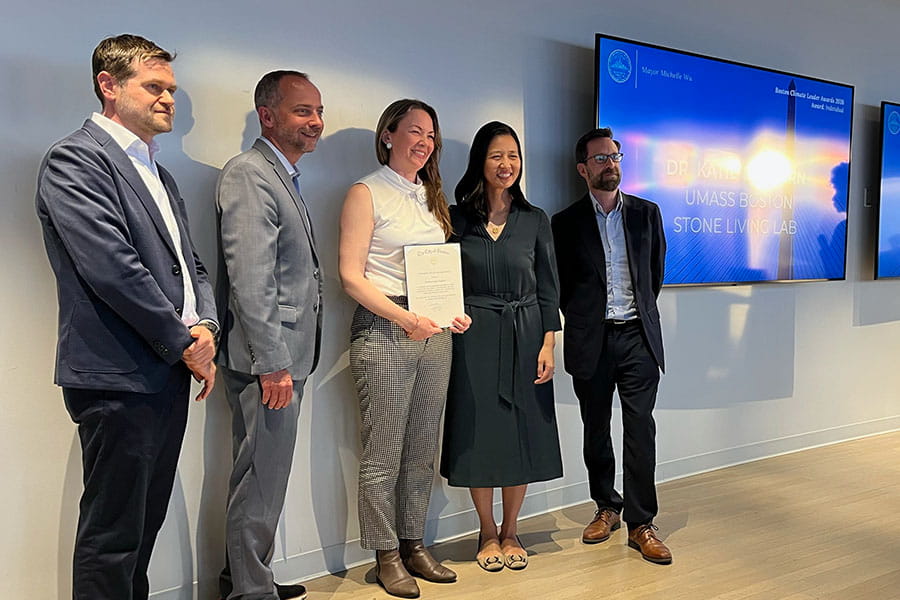
The award recognizes Dafforn's role in reimagining Boston’s coastline through the Living Seawalls project, led locally by the Stone Living Lab, which uses special panels to provide new habitats for aquatic life along existing seawalls.
The 2026 Climate Leader awards honored fifteen businesses and institutions, community groups, and individuals for their contributions to Boston’s climate goals. Boston Mayor Michelle Wu, who gave a speech at the award ceremony, said that "these Boston Climate Leader Award winners reflect the best of our city: the talent, innovation, and community-based work that is helping Boston thrive for generations to come.”

Boston Mayor Michelle Wu presents the 2026 Boston Climate Leader Awards. Image by: Jeremiah Robinson
The award-winning Living Seawalls project initially began in Sydney, Australia in 2018. Scientists from the University of New South Wales and Macquarie University joined forces with a commercial partner, Reef Design Lab, to design, construct, and install interlocking concrete panels along stretches of existing seawall.
Without modifications, seawalls offer few opportunities for aquatic life to take hold. The pockets and holes in Living Seawalls panels were designed to provide naturalistic habitats: Some panels mimic the tight folds of oyster reefs, while others resemble weathered rock pools. After years of rigorous research, the project has proven to have a significant effect on local wildlife. In Sydney harbor, Living Seawalls panels host up to 36% more species than unmodified seawalls.
A similar transformation is taking place in Boston Harbor. Thanks to Dafforn, the Stone Living Lab, and their many collaborators, in 2024, Boston became the first city in North America to install Living Seawalls panels. Today, they can be found at Condor Street Urban Wild and Fan Pier Park.
The newest surveys of the panels show some exciting developments. Not only does the carpet of living organisms on the panels reach higher than it does on a regular seawall, but the more complex panels now support more biodiversity than the flatter panels. Fucus, a long-living algae also known as rockweed, has taken root on the panels, providing shelter for snails, fish, and many other animals.
Dafforn expressed gratitude to the City of Boston for her Innovation Award, and for the city’s ongoing cooperation on the Living Seawalls project and other Stone Living Lab initiatives. She hopes that Stone Living Lab’s work testing nature-based solutions like Living Seawalls will help Bostonians engage with issues that arise when cities intersect with aquatic environments.
“It’s one of the reasons I work in environmental science,” she said, “because we can blend our incredible research of the natural environment and the built environment, with actual implementation that makes a difference in residents’ lives.” She has especially enjoyed working with Boston schools, and watching kids learn about life at the water’s edge.
Dafforn also noted that bringing the Living Seawalls project to Boston would not have been possible without her colleagues at the Stone Living Lab, the municipal, state and federal partners in the lab, and funding from the Stone Foundation and 11th Hour Racing, along with the contributions of UMass Boston students, who have monitored the panels to track their impact.
“It’s that collective work that’s helped bring life back to Boston Harbor and ensure that what we learn is shared back with the Boston community,” she said.