Digital Accessibility Exception Standard
Purpose
UMass Boston is committed to an inclusive, accessible digital environment where students, employees, applicants, visitors, and the public can access and participate in university programs, services, activities, and opportunities.
Digital accessibility is the university’s standard expectation and should be considered throughout each digital resource’s lifecycle.
Limited circumstances may arise when accessibility requirements cannot reasonably be met within the required timeframe due to documented technical, vendor, contractual, operational, transitional, or similar conditions.
This Standard establishes a consistent process for identifying, reviewing, approving, documenting, and monitoring Digital Accessibility Exceptions while preserving equitable access for individuals with disabilities.
An accessibility exception is temporary and does not remove the university’s responsibility to pursue accessibility. Each approved exception must include effective alternative access, a remediation or replacement plan, a responsible owner, an expiration date, and ongoing review.
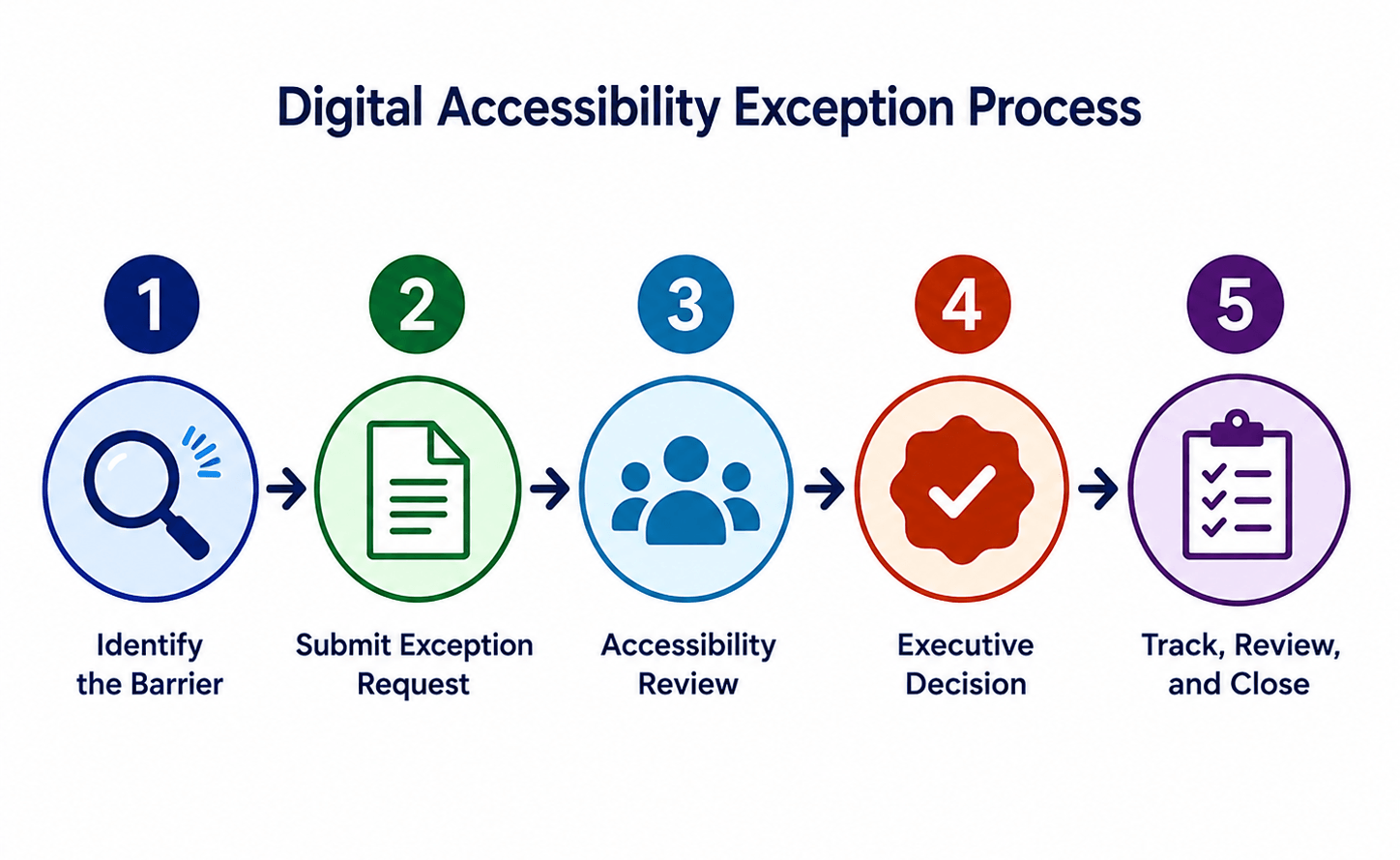
The exception process is organized into five phases:
- Identify and Assess
- Exception Request
- Digital Accessibility Office Review
- Executive Decision
- Governance and Review
These phases correspond to the university’s Digital Accessibility Exception Process infographic and should be applied consistently to all exception requests.
Authority
This Standard, issued under the authority of the Chief Information Officer, establishes UMass Boston’s process for evaluating, approving, documenting, and monitoring Digital Accessibility Exceptions in support of the Digital Accessibility Policy.
Scope
This process applies to digital information, content, services, applications, systems, and technologies owned, developed, procured, licensed, maintained, administered, or used by UMass Boston.
Covered resources include websites, applications, administrative and enterprise systems, SaaS products, learning technologies, mobile apps, documents, forms, multimedia, kiosks, research applications, digital-interface hardware, and third-party products or services.
The process applies regardless of funding source, ownership unit, or whether the technology is centrally managed, locally managed, or provided by a third party.
A pending or approved exception does not suspend the university’s responsibility to provide timely access or respond to accommodation requests, accessibility complaints, or immediate access needs.
Guiding Principles
The university’s Digital Accessibility Exception Process follows these principles:
- Accessibility is the default. Exceptions are allowed only when requirements cannot reasonably be met on time.
- Exceptions are temporary. Each exception must have an expiration date, remediation plan, and review schedule.
- Alternative access is required. Departments must provide equivalent access for the duration of the exception.
- Departments remain accountable. Approval does not transfer responsibility for remediation.
- Decisions are documented. Requests are reviewed consistently and approved by the appropriate authority.
Digital Accessibility Exception Process Overview
UMass Boston uses a five-phase process to review temporary Digital Accessibility Exception requests while keeping accessibility as the university’s default expectation.
The requesting department identifies the barrier, determines whether standard remediation is possible, and submits an exception request with a business justification, accessibility impact, alternative access plan, and remediation strategy.
After department and divisional approval, the Digital Accessibility Office reviews the request with appropriate experts and sends a recommendation to the CIO or authorized delegate. Approved exceptions are monitored, reviewed, renewed when justified, and closed when accessibility is achieved or the exception is no longer needed.
The following phases define the exception process and the responsibilities of the requesting department, reviewers, approving authority, and Digital Accessibility Office.
.png)
1. Identify the Barrier—Department
Identify the inaccessible product, service, document, or technology. Assess the impact on affected users. Determine whether the barrier can be remediated within the policy timeframe. If it can be remediated, follow the standard remediation process. If it cannot be remediated, proceed with an exception request.
Phase 1: Identify and Assess
The department identifies the affected digital resource, classifies the resource type, describes the accessibility barrier, identifies the business owner, and assesses the impact on users and university operations. This assessment should consider who uses the resource, the importance of the affected function, whether immediate access needs exist, whether an effective alternative already exists, and whether the university or a vendor controls the barrier.
If the issue can be resolved through standard remediation, configuration, maintenance, procurement of an accessible alternative, vendor support, or routine content correction, the department should proceed with remediation and the exception process ends. If the issue cannot reasonably be corrected within the required timeframe, the department may consult the Digital Accessibility Office and proceed to Phase 2.
An exception may be appropriate only when the need is documented, such as technical infeasibility, vendor dependency, temporary transition, legacy or archived content, undue burden, or fundamental alteration. Routine effort, convenience, preference, or delay alone is not sufficient.
.png)
2. Submit Exception Request—Department
Explain why accessibility requirements cannot be met. Describe the impact and risk. Provide an Equivalent Effective Alternative Access (EEAA) plan. Include a remediation plan and target date. Obtain department and Vice Chancellor approval.
Phase 2: Exception Request
Preparation of the Exception Request
The department prepares the official exception request with enough information to support review.
The request must include: business justification; proposed exception basis; accessibility impact and risk; Equivalent Effective Alternative Access plan; remediation plan, owner, milestones, dependencies, and target date; supporting documentation such as testing results, VPAT/ACR, vendor correspondence, roadmaps, cost or procurement records; and Department Head and Vice Chancellor approvals. Incomplete requests may be returned before review.
.png)
3. Accessibility Review—Accessibility Office
Coordinate the accessibility review. Gather technical, procurement, security, and legal input as needed. Develop a recommendation. Possible outcomes: Approve, Approve with conditions, Request more information or Reject.
Phase 3: Accessibility Review
The Digital Accessibility Office reviews the request for completeness, coordinates consultation with appropriate subject-matter experts, and evaluates the barrier, risk, proposed exception basis, supporting evidence, EEAA plan, remediation plan, requested duration, and vendor or institutional implications.
The Office may request additional information, revised remediation dates, updated testing or vendor documentation, stronger alternative access measures, or additional departmental commitments before preparing a recommendation for the CIO or authorized delegate.
The Digital Accessibility Office will complete an initial review within 10 business days of receiving a complete request or will request additional information. Complex requests may require additional consultation before a recommendation is issued.
.png)
4. Executive Decision—CIO/Leadership
The CIO or delegate reviews the recommendation. The decision is communicated to the requester. If approved, the EEAA and remediation plan must be implemented. Possible decisions: Approved, Approved with conditions, Returned for more information or Not approved.
Phase 4: Executive Decision
The CIO or authorized delegate is the final approving authority and issues a written decision to approve, approve with conditions, deny, or request more information. The decision considers institutional accountability, operational continuity, legal obligations, financial considerations, risk management, good-faith remediation efforts, and the adequacy of the EEAA and remediation plans.
Approved exceptions must include an effective date, expiration date, review schedule, conditions if any, an active EEAA plan, and a remediation plan. Approval is temporary and does not make the resource accessible or remove departmental responsibility. Denied requests must proceed through standard remediation, replacement, discontinuation, delayed implementation, or another required corrective action.
.png)
5. Track, View, and Close—Ongoing Oversight
Record the approved exception. Periodically review its status and risk. Renew, remediate, or close the exception as appropriate.
Phase 5: Governance and Review
The Digital Accessibility Office records approved exceptions in the Accessibility Exception Register, which serves as the official record for monitoring, accountability, executive oversight, institutional reporting, and closure.
Each register entry should include the Exception ID, business owner, affected resource, approved basis, EEAA summary, remediation plan, approval conditions, effective date, expiration date, and review schedule. Departments must keep information current, report material changes promptly, maintain alternative access, and continue remediation.
Approved exceptions are reviewed by risk level: Critical every 6 months, High every 12 months, Medium every 24 months, and legacy or archived content as determined during approval. Reviews confirm whether the exception remains necessary, conditions are being met, EEAA remains effective, and remediation is progressing.
Exceptions do not renew automatically. Renewal requires updated justification, current barrier status, evidence of progress, updated vendor or remediation information, revised dates when needed, requested renewal period, and Department Head and Vice Chancellor approval before expiration. Repeating the original request without progress may result in denial.
An exception closes when the barrier is resolved, the vendor corrects the issue, the resource is replaced or retired, the affected function is discontinued, or the exception is no longer needed. Reconsideration of a denial or condition must be requested within the authorized timeframe and requires new or materially different information; it does not delay immediate access, accommodation, remediation, or compliance responsibilities.
Submission and Assistance
Departments should consult the Digital Accessibility Office before preparing a formal exception request. Many barriers can be resolved through standard remediation, technical guidance, or support without an exception.
To request assistance or begin the process, complete the university’s Digital Accessibility Help & Support form.
After submission, the Digital Accessibility Office will review the request and may:
- Provide guidance or consultation.
- Recommend remediation that avoids an exception.
- Request more information.
- Start the formal exception process when appropriate.
Departments should prepare a formal exception request only when directed by the Digital Accessibility Office.