Research & Impact
The College of Management at UMass Boston drives impactful business research that connects rigorous scholarship with real-world solutions.
Our faculty excel in organizational leadership, entrepreneurship and innovation, corporate social responsibility, sustainability, business ethics, strategic management, marketing and consumer insights, accounting and finance, and management information systems/digital transformation.
Located in Boston’s vibrant innovation ecosystem, we address critical issues like climate change, diversity and inclusion, and equitable economic development. Faculty regularly publish in top Financial Times 50 journals such as Academy of Management Review, Journal of Business Ethics, MIS Quarterly, and Journal of Financial Economics, while leading community-engaged projects and thought-leadership initiatives like the International Conference on Corporate Social Responsibility.
Projects, Initiatives & Highlights


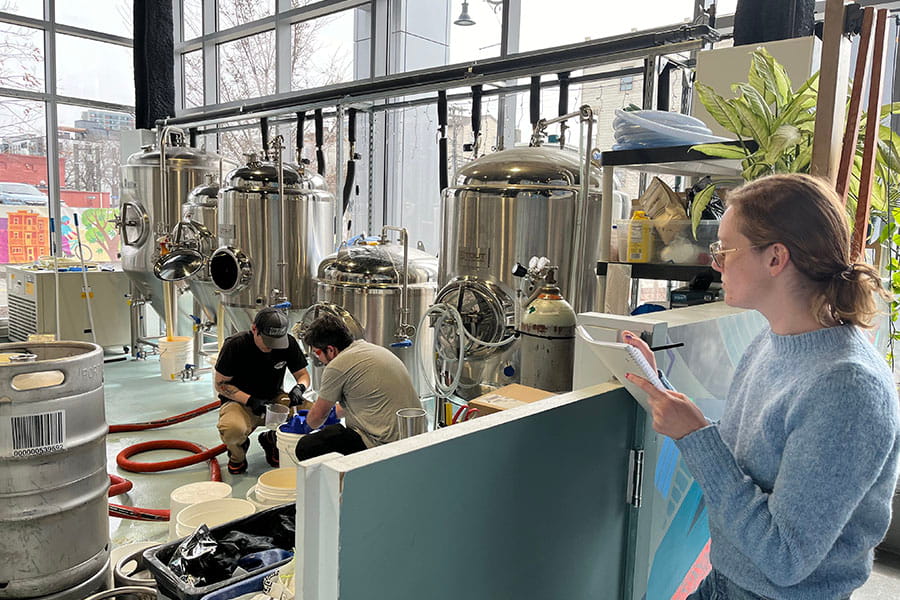
Centers in the College of Management
Center for Collaborative Leadership
For over two decades, the College of Management Center for Collaborative Leadership has actively developed future leaders of all backgrounds through its Emerging Leaders Program, United States Coast Guard Academy (USCGA) Scholars Program, and custom options for every type of organization who wants to invest in their employees. With over 900 alumni from notable companies in the greater Boston area and beyond, the Center has been working hard to ensure that our future will be in capable hands.
Center for Sustainable Enterprise and Regional Competitiveness
The Center for Sustainable Enterprise and Regional Competitiveness collaborates with businesses, universities, and policymakers to advance research, education, and innovative solutions. With a mission to foster a transition to a clean, sustainable, and prosperous economy, the center aims to understand the interactions between business and environmental issues to facilitate the transformation of business practice and decision-making processes.
Recent Publications
- Kunz, W.H., Sajtos, L. and Flavián, C. (2025) ‘Beyond replacement: Human–machine collaboration in the age of AI’, Journal of Service Management, 36(4), pp. 477–494.
- Le, K.B.Q., Sajtos, L., Kunz, W.H. and Fernandez, K.V. (2025) ‘The future of work: Understanding the effectiveness of collaboration between human and digital employees in service’, Journal of Service Research, 28(1), pp. 186–205.
- Syed, R., Silva, L. O., & Oladeji, O. (2025) ‘Beyond Slacktivism: Unraveling the Power of Peripheral Mobilization through Social Media Talk and Ties’, MIS Quarterly.
- Bhattacharyya, B., Erskine, S.E. and McCluney, C. (2024) ‘Not all allies are created equal: A relational examination of effective allyship for women of color at work’, Organizational Behavior and Human Decision Processes, 182, Article 104331.
- Chen, T., Bai, J.J., Martin, X. and Wan, C. (2024) ‘Platformprovided disclosure on investor base and entrepreneurial success: Evidence from crowdfunding’, The Accounting Review, 99(5), pp. 97–122.
- Choi, A., Kim, J.B., Lee, J. and Park, J.C. (2024) ‘Market for corporate control and demand for auditing: Evidence from international M&A laws’, Review of Accounting Studies, 29(3), pp. 2753–2797.
- Ertugrul, M., Krishnan, K. and Yu, Q. (2024) ‘Knowledge spillover and entrepreneurship: Evidence from BITNET’, Research Policy.
- Naya, P., Contu, A. and Poole, J. (2024) ‘Piercing the veil of colorblindness with an antiracist identity: Sensemaking, power, and the reproduction of racialized socioeconomic inequality’, Academy of Management Learning & Education, 43(3), pp. 387–407.
- Zhao, Y., Zhang, D. and Zhang, Y. (2024) ‘Lending relationships and the pricing of syndicated loans’, Management Science, 70(2).
- Zheng, L., Mai, F., Yan, B. and Nickerson, J.V. (2024) ‘Stigmergy in open collaboration: An empirical investigation based on Wikipedia’, Journal of Management Information Systems, 40(3), pp. 983–1008.
Get Involved
At the College of Management, our research doesn’t stop at publications - it creates real-world change. Through thought leadership, community partnerships, and innovative programs, our faculty and students are actively shaping a more sustainable, ethical, and resilient future.