Robert C. Wood: His Life, Legacy, & Lessons
Compiled and written by Marcy Murninghan
- Metropolitan Governance
- Urban Innovation
- Institutional Accountability & Fighting Corruption
- Housing & Community Development, Public Transportation, & Public Education
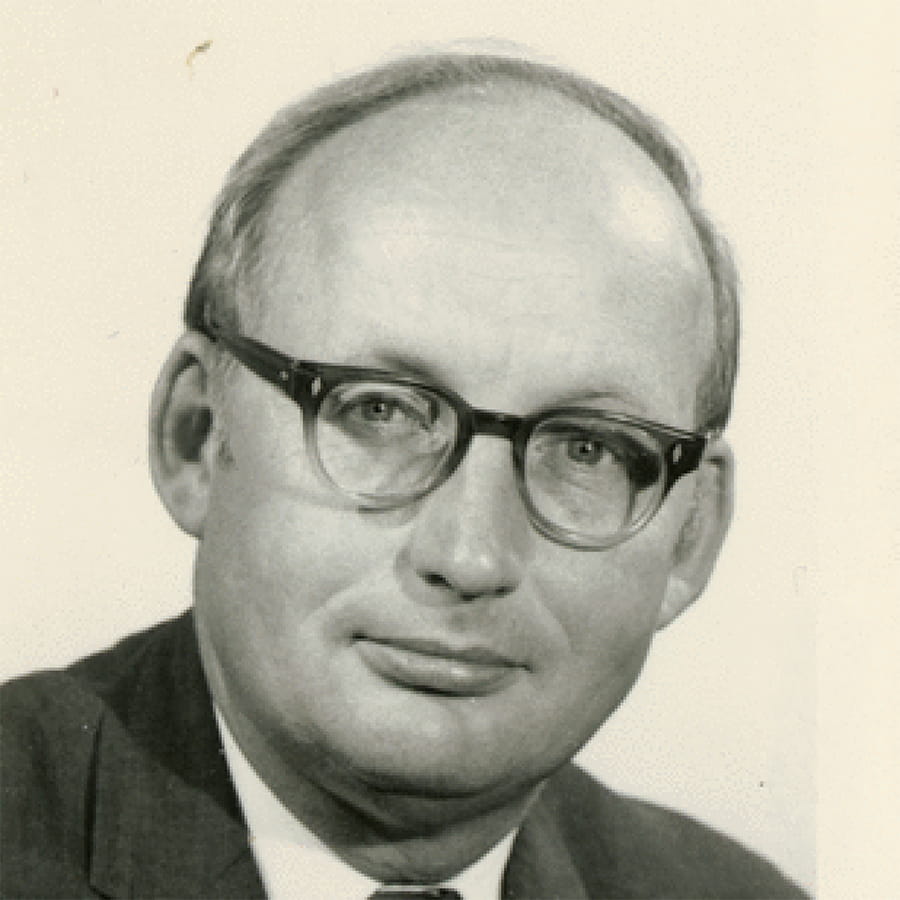
Scholar-practitioner of American urban affairs and presidential adviser to John F. Kennedy and Lyndon B. Johnson.
Metropolitan Governance
Robert Coldwell Wood’s consequential career touched nearly every level of urban U.S. and Boston-area governance: scholar, federal budget examiner, presidential advisor, under secretary and secretary of the U.S. Department of Housing and Urban Development, MBTA chairman, UMass president, and Boston Public Schools superintendent during court-ordered desegregation.
During the post–World War II migration from farm to city, Wood was among a small cohort of noted “urbanists” calling for metropolitan approaches to urban governance that complemented decentralized control, character, and quality of life. His approach recognized that “flows of ideas” transcend city limits.
“Dynamic systems theory” characterized this approach. Arising from Jay W. Forrester’s pioneering digital computer engineering work for the U.S. Navy during the 1940s and 1950s, and later at MIT, Forrester’s Digital Computer Lab cultivated the idea of networks and nodes, that we live in a complex world of permeable “borders,” with large urban areas more like city-states than bounded communities. Forrester’s book, The City: Growth, Stagnation, and Revival (1969) revolutionized urban planning by introducing feedback loops and design resilience, features that Wood embraced whole-heartedly.
As scholar, policy maker, and practitioner, Wood’s accomplishments during this “metropolitan governance” era included the following:
- His landmark study of suburban political behavior, Suburbia: Its People and Their Politics (1958), which helped popularize idea of suburbia and examined how fragmented local governments shape metropolitan life
- His work for the Washington, DC-based Committee for Economic Development, which analyzed how fragmented governmental structures undercut coordinated metropolitan planning and resulted in publication of Metropolis Against Itself (1959)
- His participation in a research team led by noted economist Ray Vernon, which resulted in publication of nine books, including Wood’s 1400 Governments: The Political Economy of the New York Metropolitan Region
- His later position as Henry Luce Professor of Democratic Institutions and Social Order and the John E. Andrus Professor of Government at Wesleyan University (1983–1993), where his work centered on democratic institutions, governance, and public accountability
- His 1989 recognition by the American Political Science Association for his lifetime contributions to the study of urban and metropolitan politics
- His service on the Board of Trustees of both the Charles F. Kettering Foundation, which concentrates on democracy and civic engagement, and the Cambridge, MA-based Lincoln Institute of Land Policy, which covers land policy, planning, and metropolitan development
Amidst it all, Wood well knew that the perennial tension between “bigness” and “smallness,” between “centralized” and “decentralized,” must always be managed. Nevertheless, in a speech he made on Independence Day on July 4, 1968, he stated his belief in both:
“I would make two reforms in political power at the local level. If we are to govern urban America, I believe we need a greater consolidation of authority at the metropolitan level and a decentralization of authority at the neighborhood level. These arrangements are not as contradictory as they may first appear.”
— Robert C. Wood, “Urban Independence,” 1968
Urban Innovation
Throughout his academic and administrative career, Bob Wood was a “design thinker” who embraced reformist ideas and new policy approaches. As he would later write in his unpublished memoirs, this creative impulse found expression as a Harvard PhD student in government, but it was forged through his experience in the Jim Crow South, the Great Depression, and World War II. Some of these formative experiences include the following:
- His early civil service days in Florida and Washington, DC (1950–1960), working within newly created government bureaus designed to professionalize operations and eradicate self-dealing, fraud, and racial discrimination
- His work at MIT in the early 1960s, where he taught political science (twice serving as department chair) and, with noted scientist and former MIT President James Killian, developed the school’s first course on science, technology, and public policy
- His early involvement as a member of a Democratic National Committee’s Urban Advisory Committee and President John F. Kennedy’s “brain trust” in the early 1960s
- His vital role in helping to create and fulfill President Lyndon B. Johnson’s Great Society domestic agenda (1965–1969), chairing two of Johnson’s outside and interagency task forces comprising academics, business leaders, nongovernmental experts, and representatives from different federal departments, which led to his work helping to establish the U.S. Department of Housing and Urban Development as well as developing the experimental federal urban-renewal and community-development initiative known as the Model Cities Program (1966)
- His return to Massachusetts and academe (1969–1977) as director of the MIT-Harvard Joint Center for Urban Studies and his 1970 appointment as president of the University of Massachusetts, begun under the inaugural theme of “innovation,” wherein which he presided over the construction and expansion of UMass Boston, the establishment of UMass Medical Center (now UMass Chan Medical School) in Worcester, and his successful effort to personally persuade Jackie Kennedy Onassis to locate her late husband’s presidential library and museum at Columbia Point
- His brief tenure as the “reform superintendent” of the Boston Public Schools (BPS), appointed to preside over court-ordered desegregation and implement the federal court’s remedial orders (1978–1980), during which he successfully reorganized and decentralized the BPS administrative structure to improve system quality, accountability, and responsiveness, while also complying with outstanding court orders related to the 14th Amendment of the U.S. Constitution
Wood’s section on “The Perils of Innovation Politics” in Chapter 6 of his unpublished memoirs described a “politics of innovation”—manifest in John Kennedy’s New Frontier but most prominent in Lyndon B. Johnson’s Great Society—instead of the more traditional “politics of redistribution.” But the challenge of translating rhetoric into reality was never easy. That said, here we stand, on an urban campus adjacent to a presidential library, which is the direct result of his vision and political acumen.
Key to it all, he believed, is adaptive resilience:
“Our political leaders must continuously measure their powers and resources against the new public problems they are expected to solve. Only if they adapt the government to fit these problems, only if they remain deeply dissatisfied, can the community or the nation withstand the onslaughts of deeply dissatisfied revolutionists.”
— Robert C. Wood, “Urban Independence,” 1968
Institutional Accountability & Fighting Corruption
Institutional accountability and fighting corruption were not just subplots in Bob Wood’s life—they were prominent themes running throughout it. From his boyhood in Depression-era Jacksonville to his memoirs’ final chapter (“Corruption: Who’s the Most Guilty?”), across seven decades and six institutions, Wood kept encountering the same dynamics. His answer to the title question, in the form of a subhead, was, “All of us, but some of us more than others.” He continued by writing,
Public wrongdoing is more venal than private, for at stake is the public trust. The public sector alone can take lives and conscript soldiers. Only when misconduct is identified early and pursued vigorously does the culture of public service come to be respected.
But, and this is vital, genuine widespread corruption of public activities almost always involves the private sector. Except for the rare instance of fraud within a public agency, private concerns and individuals are almost always present. Thus, vigilance for possible wrongdoing is an administrative imperative—acknowledged, put in place professionally, routinely renewed, and evaluated.
Through it all, Wood was guided by a moral compass but always stressed that it wasn’t enough. Institutional checks, balances, and structural mechanisms also were required.
Significant examples of Wood exemplifying this include the following:
- As a management organization examiner in the U.S. Bureau of the Budget (1951–1954), where he cataloged specific instances of corruption affecting agencies such as the IRS, Reconstruction Finance Corporation, and federal Housing and Home Finance Agency
- As undersecretary and, briefly, secretary at the U.S. Department of Housing and Urban Development (1966–1969), where he recognized that ethical safeguards require constant managerial diligence, noting they were “fortunate in President Johnson’s administration—and also vigilant—to have made special arrangements for investigatory oversight when new programs were established,” a reference to the inspector general idea he first raised in 1955
- As chair of the MBTA Board (1970–1971), then undergoing revitalization, where he witnessed the gap between “policy” and “implementation” as political favoritism, patronage, kickbacks, and racial bias reigned. His chief insight: “Local grassroots government ‘closest to the people’ was most likely to be the most corrupt, as well as the most provincial.”
- As president of the University of Massachusetts (1970–1977), when news broke that a private company overseeing construction of the new UMass Boston campus had enabled shoddy construction of an underground parking garage—a byproduct of systemic corruption and kickbacks that led to convictions and, ultimately, reforms that included creation of a state Office of Inspector General
- As superintendent of the Boston Public Schools (1978–1980), following court-ordered desegregation, wherein he was appointed by a reform-minded School Committee but fired two years later by a very different one, with three of its five members under FBI investigation for bribery. Nevertheless, Wood carried out a state-mandated reorganization that accomplished significant court-ordered reforms.
In his 1968 “Urban Independence” speech at Faneuil Hall, Wood said repeatedly that elections are not enough to assure democracy’s vitality: “We must meet the challenge of monitoring and upgrading our institutions while assuring they are managed with resilience and civic moral integrity.”
“...Participation in government administration is as necessary as participation in the election of its leaders in a time when complex and complicated programs and instruction necessarily impinge on our lives. Not just participation in voting, but in planning and management operations, is needed today.”
— Robert C. Wood, “Urban Independence,” 1968
Housing & Community Development, Public Transportation, & Public Education
Three interrelated policy realms dominated Robert Wood’s life:
- Housing and community development
- Public transportation
- Public education, both post-secondary and secondary.
From the 1950s through the mid-1990s, Wood’s work occurred within the changing character of American life. Americans were on the move, both laterally—from farm to city, city to suburb, one region to another—and vertically—from modest beginnings up the ladder to material success. Yet problems were emerging, as growing social and political fractures would, by the 21st century, produce widespread mistrust in government, polarization, and massive economic inequality.
Indeed, the arc of Wood’s professional history resonates today: from the Truman era and the Cold War, to an unpopular war in Vietnam; the political assassinations of Rev. Dr. Martin Luther King, Robert F. Kennedy, and Malcolm X; rising campus radicalism and a declining college-age population; economic dislocation and deindustrialization; an oil shortage and high gas prices; and plummeting trust in the capacity of public institutions to do good work. Add to this the emergence of environmentalists calling for limited growth, new technologies such as personal computers, mobile phones, and something called the World Wide Web, and rising demands for human rights and affirmative action. What was government to do?
Wood’s answers hold lessons for how we might meet today’s challenges. They include these strategies:
- Mix insiders with outsiders to create new usable knowledge: Be it at the U.S. Department of Housing and Urban Development, the MBTA, the UMass system, or the Boston Public Schools, Wood integrated talented staff drawn from academe or think tanks to join him within existing systems. He knew there was a constant need to co-create new “usable knowledge” to achieve policy goals and align systems.
- Build new partnerships: Wood broke new ground (literally and figuratively) in creating partnerships and pooling resources. He did this with public housing and community development, from the Truman days to the Great Society’s Model Cities; public transportation, as chair of the MBTA; public higher education, as president of the UMass system and, by extension, his role in siting the John F. Kennedy Presidential Library and Museum nearby; and public secondary education, as Boston Public Schools superintendent, appointed to help bring about court-ordered reform.
- Transform institutions: Wood’s brand of public administration also featured organizational restructuring to better achieve policy objectives. Late in life, he wrote about the power of technology, a throwback to his MIT days in the 1950s and 1960s.
From today’s vantage point, his body of work is a sturdy baseline affecting how we might achieve the American dream of equality and justice, of life, liberty, and the pursuit of happiness, however imperfectly. He knew that even as there’s no single morality to show us the way, we still should try.
With ringing resonance to our current quest to reset our civic moral compass, Robert Wood’s words rang clear. On July 4, 1968, he said, “It is to the common needs of Americans for productive jobs, good schools, sound homes, safe streets that our governments must respond, and it is in common endeavors that this nation flourishes.” Doing this, he pointed out, involves “the pluralism of our heritage,” which challenges directly a “monopoly on morality.”
“Such is the variety of our occupations and interests, that we are statistically ordained to be a nation of minorities. We find our nationhood overleaping this historical fact. Those who would attribute to one race, one religion, or one generation a monopoly on morality, those who assert the exercise of power without resort to reason or assent, risk more than their own fortunes. They undercut our entire political culture. They betray 192 years of lessons born of pain and hard work.”
— Robert C. Wood, “Urban Independence,” 1968